Publications
2026

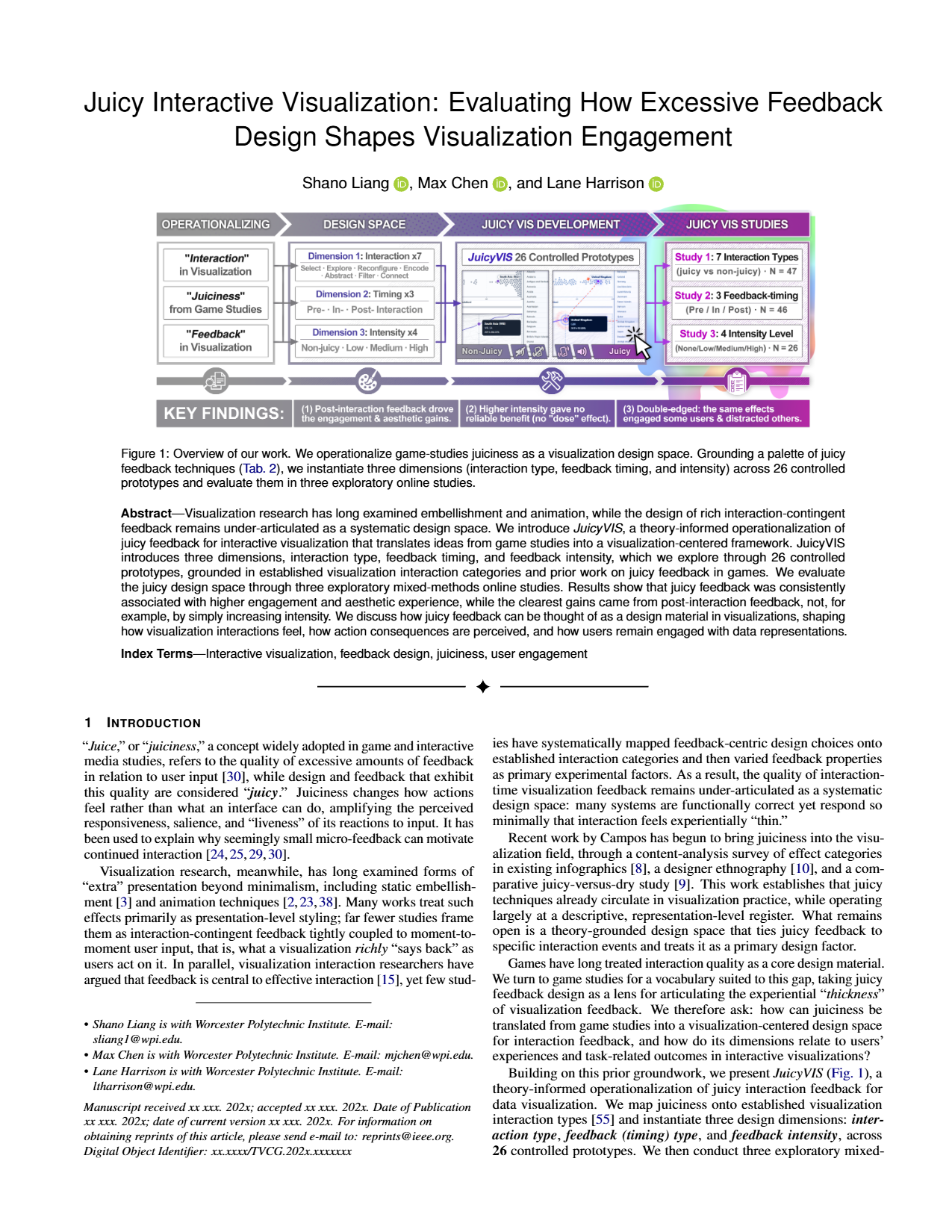
Visualization research has long examined embellishment and animation, while the design of rich interaction-contingent feedback remains under-articulated as a systematic design space. We introduce JuicyVIS, a theory-informed operationalization of juicy feedback for interactive visualization that translates ideas from game studies into a visualization-centered framework. JuicyVIS introduces three dimensions, interaction type, feedback timing, and feedback intensity, which we explore through 26 controlled prototypes, grounded in established visualization interaction categories and prior work on juicy feedback in games. We evaluate the juicy design space through three exploratory mixed-methods online studies. Results show that juicy feedback was consistently associated with higher engagement and aesthetic experience, while the clearest gains came from post-interaction feedback, not, for example, by simply increasing intensity. We discuss how juicy feedback can be thought of as a design material in visualizations, shaping how visualization interactions feel, how action consequences are perceived, and how users remain engaged with data representations.
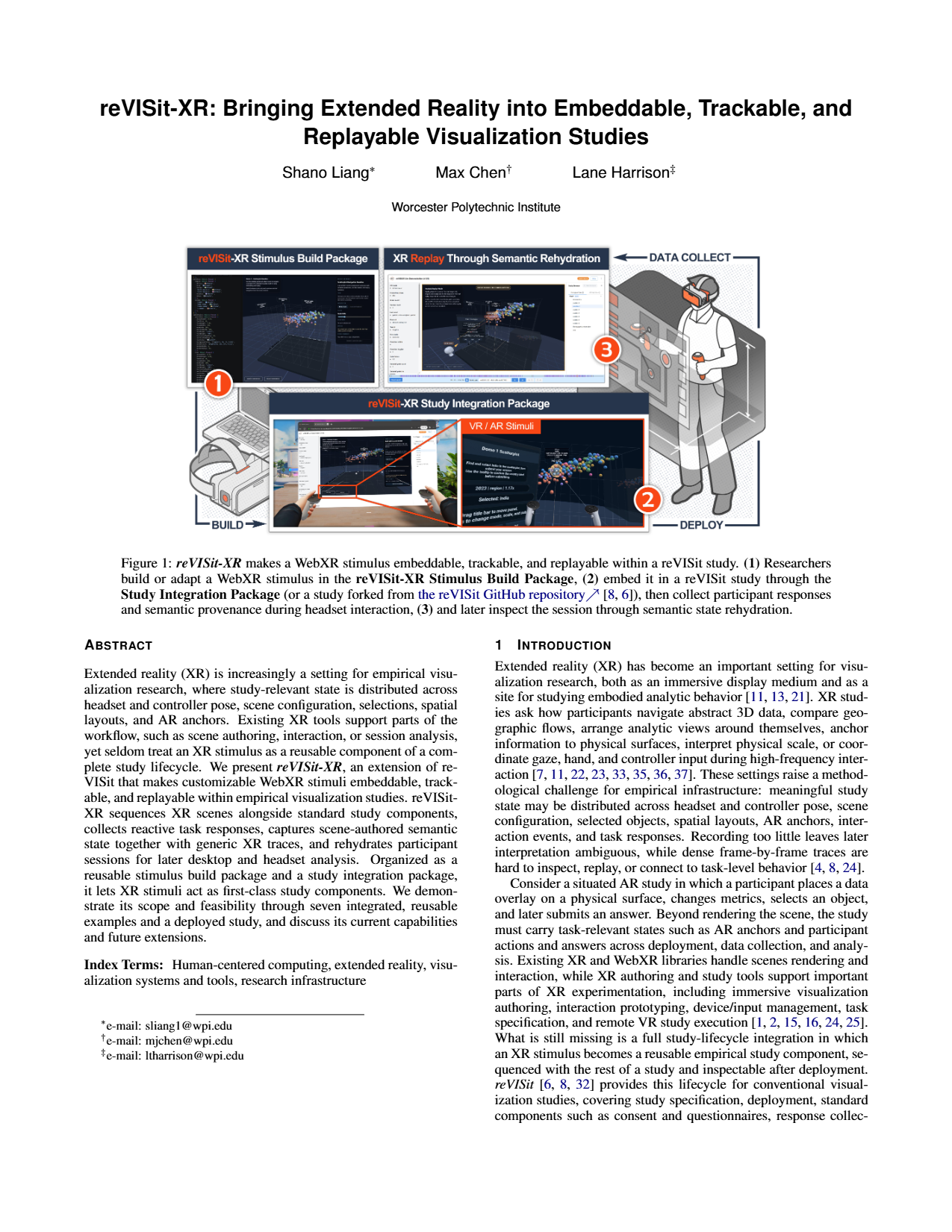
Extended reality (XR) is increasingly a setting for empirical visualization research, where study-relevant state is distributed across headset and controller pose, scene configuration, selections, spatial layouts, and AR anchors. Existing XR tools support parts of the workflow, such as scene authoring, interaction, or session analysis, yet seldom treat an XR stimulus as a reusable component of a complete study lifecycle. We present reVISit-XR, an extension of re-VISit that makes customizable WebXR stimuli embeddable, trackable, and replayable within empirical visualization studies. reVISit-XR sequences XR scenes alongside standard study components, collects reactive task responses, captures scene-authored semantic state together with generic XR traces, and rehydrates participant sessions for later desktop and headset analysis. Organized as a reusable stimulus build package and a study integration package, it lets XR stimuli act as first-class study components. We demonstrate its scope and feasibility through seven integrated, reusable examples and a deployed study, and discuss its current capabilities and future extensions.
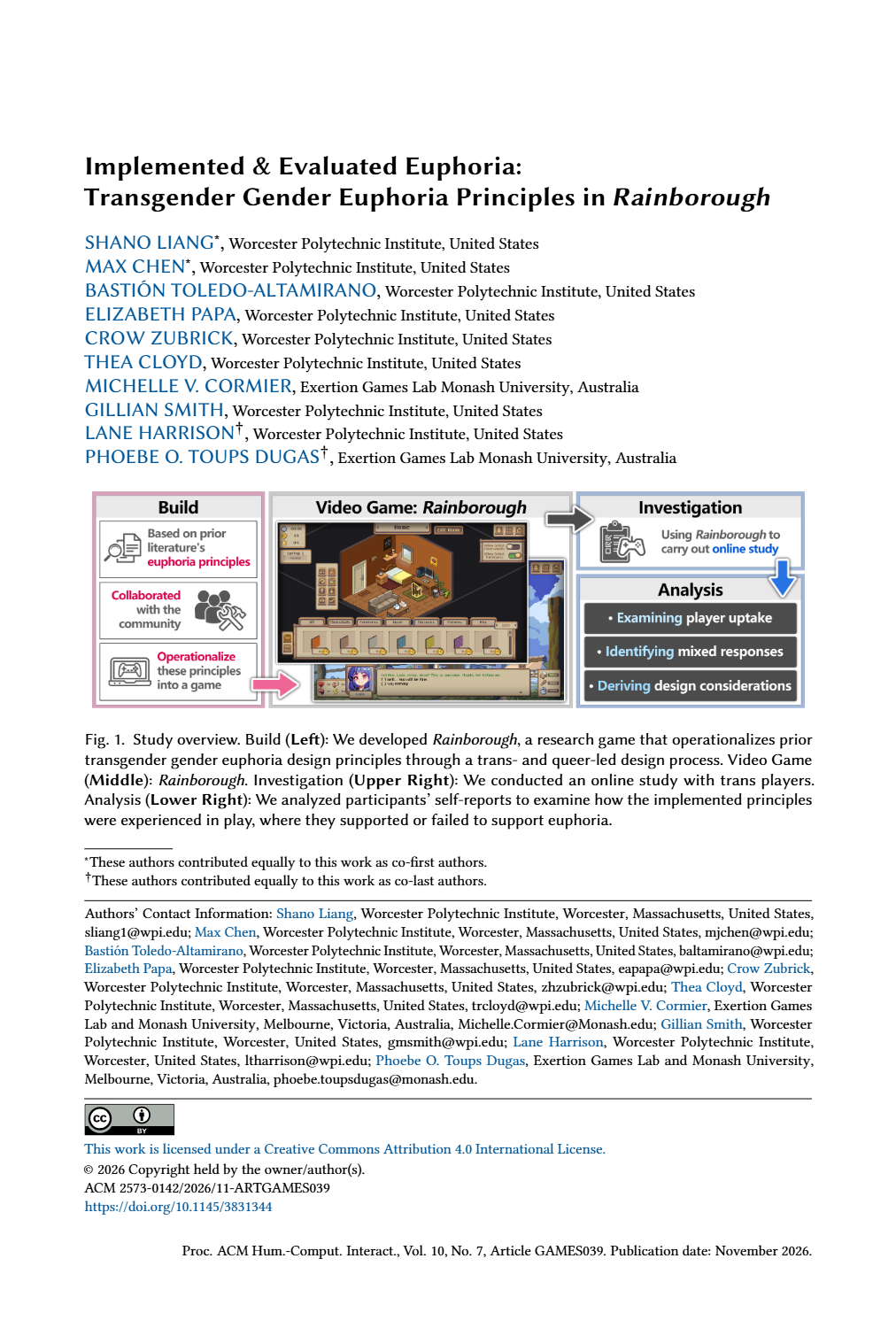
Gender euphoria refers to a range of positive feelings of satisfaction, relief, affirmation, and self-actualization that can arise when one's gender identity feels congruent with experience, expression, and recognition. Prior work has shown that games can support gender euphoria for transgender players, but less is known about how euphoria principles operate when implemented in a playable game artifact. We developed Rainborough, a research game that translates prior transgender gender euphoria design principles into interlinked narrative, parasocial, and customization systems. Rainborough centers two authored trans binary major NPC arcs, while supporting nonbinary player-character configuration and gender-diverse side characters; we treat this scope as a limitation rather than as coverage of all trans and gender-diverse euphoria. We conducted an online study with 56 trans players and used reflexive thematic analysis of free-response data, supported by descriptive ratings as contextual evidence, to explore players' responses. Findings show how Rainborough supported euphoria for some players while producing non-euphoric, ambivalent, or insufficient experiences for others. We identify design complexities and tensions around discomfort, affirmation, obscured representation, and binary-centered narrative scope, and derive design implications for future games that seek to support transgender gender euphoria.
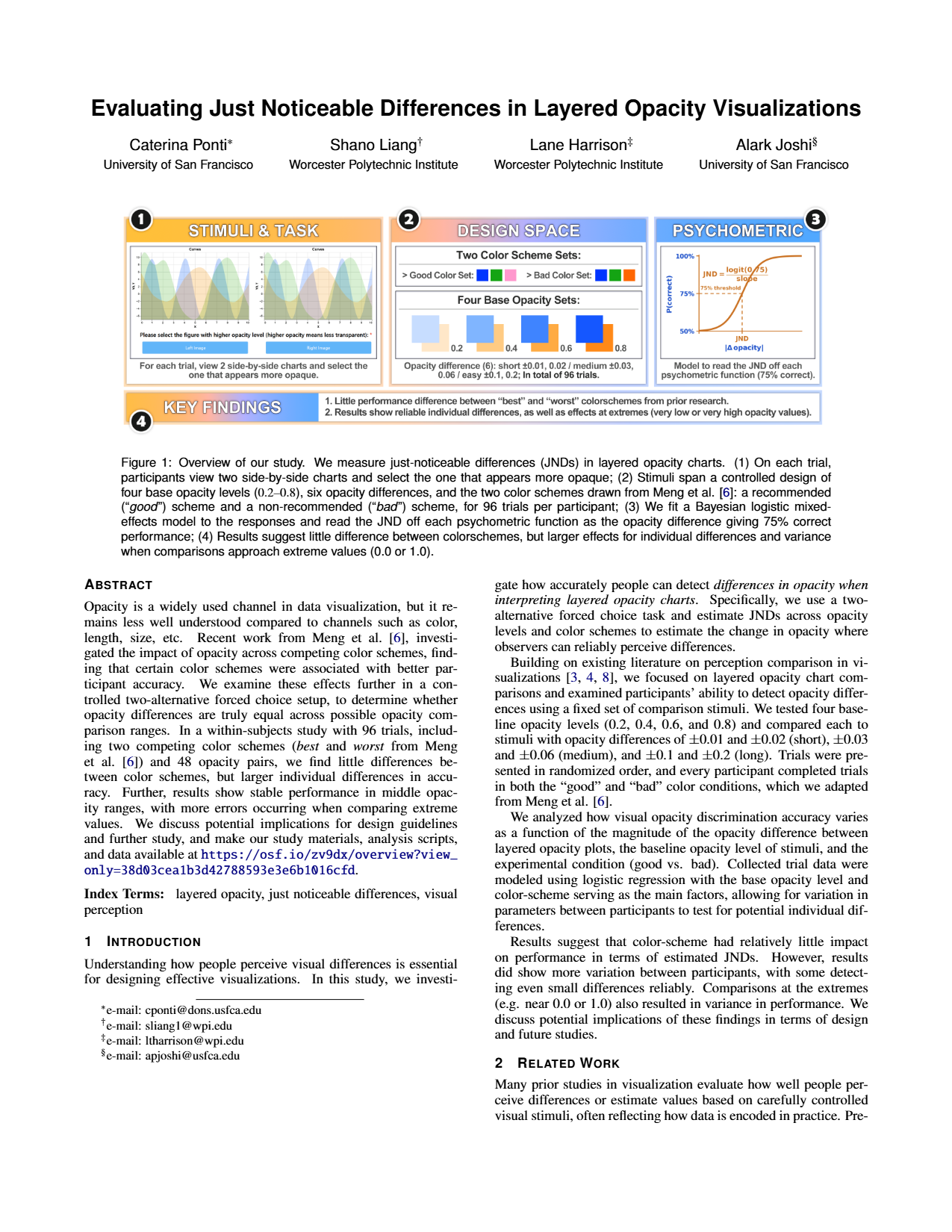
Opacity is a widely used channel in data visualization, but it remains less well understood compared to channels such as color, length, size, etc. Recent work from Meng et al. investigated the impact of opacity across competing color schemes, finding that certain color schemes were associated with better participant accuracy. We examine these effects further in a controlled two-alternative forced choice setup, to determine whether opacity differences are truly equal across possible opacity comparison ranges. In a within-subjects study with 96 trials, including two competing color schemes (best and worst from Meng et al.) and 48 opacity pairs, we find little differences between color schemes, but larger individual differences in accuracy. Further, results show stable performance in middle opacity ranges, with more errors occurring when comparing extreme values.
@inproceedings{Seaborn2026Radical,
author = {Seaborn, Katie and Liang, Shano and Mae Williams, Rua and Toups Dugas, Phoebe O.},
title = {Radical Gender Neutrality: Agender Euphoria in Gaming and Play Experiences},
year = {2026},
isbn = {9798400722783},
publisher = {Association for Computing Machinery},
address = {New York, NY, USA},
doi = {10.1145/3772318.3790659},
booktitle = {Proceedings of the 2026 CHI Conference on Human Factors in Computing Systems},
articleno = {1308},
numpages = {20},
series = {CHI '26}
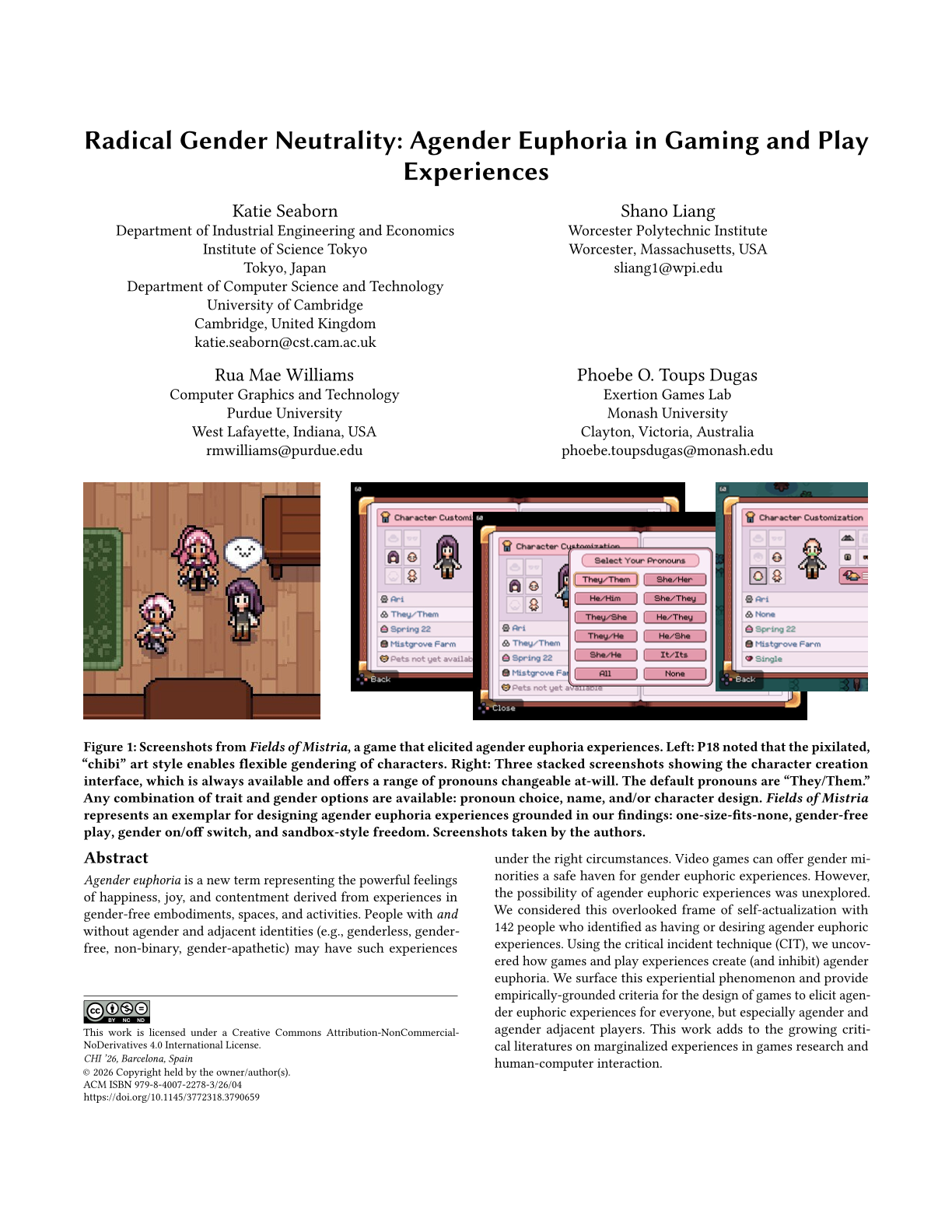
} Agender euphoria is a new term representing the powerful feelings of happiness, joy, and contentment derived from experiences in gender-free embodiments, spaces, and activities. People with and without agender and adjacent identities (e.g., genderless, gender-free, non-binary, gender-apathetic) may have such experiences under the right circumstances. Video games can offer gender minorities a safe haven for gender euphoric experiences. However, the possibility of agender euphoric experiences was unexplored. We considered this overlooked frame of self-actualization with 142 people who identified as having or desiring agender euphoric experiences. Using the critical incident technique (CIT), we uncovered how games and play experiences create (and inhibit) agender euphoria. We surface this experiential phenomenon and provide empirically-grounded criteria for the design of games to elicit agender euphoric experiences for everyone, but especially agender and agender adjacent players. This work adds to the growing critical literatures on marginalized experiences in games research and human-computer interaction.
@article{Chen2026developing,
  title={Developing A Video Game with Gender Euphoria Themes: A Postmortem of Rainborough},
  author={Chen, Max and Liang, Shano and Toledo-Altamirano, Basti{\'o}n and Papa, Elizabeth and Zubrick, Crow and Cloyd, Thea},
  year = {2026},
  doi={10.17613/wvepr-20076},
  ISSN={2328-9414},
  pages={19--35},
  volume = {4},
  publisher = {Play Story Press},
  address = {Pittsburgh, PA, USA},
  journal = {Journal of Games, Self, \& Society}
} This paper presents a postmortem of Rainborough, a video game prototype developed to explore how transgender gender euphoria themes can be implemented into game design and development. While studies on trans identities have often emphasized gender dysphoria, recent scholarship highlights gender euphoria as an important yet understudied phenomenon linked to affirmation, resilience, and well-being. Building on previous theoretical work, Rainborough was created by a team of queer and trans developers, incorporating lived experiences into its narrative and mechanics. The game combines simulation and interactive novel elements, with design choices that aim to foster expression, affirmation, and destigmatization. Using a postmortem approach, we reflect on the design and development process, examining what worked well, where challenges emerged, and what might be done differently. Our analysis contributes to designers and developers by demonstrating how the gender euphoria topic can be enacted into interactive media practice, and by offering insights for future designers and researchers interested in creating inclusive and affirming game experiences.
2025
@article{Liang2025TheThreeSteps,
author = {Liang, Shano and Cormier, Michelle V. and Toups Dugas, Phoebe O. and Bohrer, Rose},
title = {The Three Steps to Trans Death: Introducing Trans Cyber-Necropolitics in Digital Media},
year = {2025},
publisher = {Association for Computing Machinery},
address = {New York, NY, USA},
volume = {32},
number = {5},
issn = {1073-0516},
doi = {10.1145/3745767},
journal = {ACM Trans. Comput.-Hum. Interact.},
month = oct,
articleno = {54},
numpages = {34}
} Many trans people experience marginalization and violence in cyberspace. This violence is characterized by intricate dynamics surrounding voice, identities, bodies, and social interactions. To comprehend and provide a theoretical framework for this enduring phenomenon of digital violence, the present research introduces the concept of Trans Cyber-Necropolitics (TCN). TCN is a necropolitical system that explains how digital media enforce the disposability of trans people in cyberspace. We decompose this digital death into three steps: sensing, targeting, and invisible killing. Combining with the authors' positionality as transgender gamers, we provide a critical analysis of how each step operates, conducted via a meticulous examination of games, as well as an exploration of the discourse from game design and community-side comments through the lens of critical discourse analysis. Building on this analysis, we ideate how each step could be disrupted with resistance strategies and technological measures.
@article{Liang2025Jubensha,
author = {Liang, Shano and Chen, Max and Toups Dugas, Phoebe O. and Smith, Gillian and Bohrer, Rose},
title = {The Collaborative Sensemaking Play of Jubensha Games: A Deconstruction, Taxonomy, and Analysis},
year = {2025},
publisher = {Association for Computing Machinery},
address = {New York, NY, USA},
volume = {3},
number = {1},
doi = {10.1145/3721121},
journal = {ACM Games},
month = mar,
articleno = {6},
numpages = {34}
} Jubensha games, popular in China, combine storytelling, social deduction, and script-centered group play, sparking widespread interest among gamers and researchers worldwide. However, enthusiasts and researchers have struggled to accurately describe Jubensha, often defaulting to comparisons with genres like murder mystery and live-action role-playing games. This reliance on comparisons hinders efforts to generalize Jubensha or to deconstruct and adapt its unique design components, dynamics of player interaction, and playing experience into other games. This research provides a taxonomy and analysis of Jubensha games, based on a thematic analysis of over 80 Jubensha games accessed through mobile applications and physical copies. The analysis combines the authors' positionalities as native Chinese and English speakers and lenses from close reading of the games, discourse analysis, and distributed cognition. We provide summative case studies to exemplify our taxonomy and discuss design implications for Jubensha games for future projects. Our work provides a descriptive tool and vocabulary for researchers and designers to facilitate communication and theorize the evolving Jubensha gaming phenomenon highlighting how gameplay centers collaborative sensemaking. In addition, we argue that the design of game narratives in Jubensha games, including structures in scripts and the evolving performance of players, can be generalized and transferred to the design of a wider range of analog and video games.
@inproceedings{Liang2025Euphoria,
author = {Liang, Shano and Cormier, Michelle V and Bohrer, Rose and Toups Dugas, Phoebe O.},
title = {Designed \& Discovered Euphoria: Insights from Trans-Femme Players' Experiences of Gender Euphoria in Video Games},
year = {2025},
isbn = {9798400713941},
publisher = {Association for Computing Machinery},
address = {New York, NY, USA},
doi = {10.1145/3706598.3714081},
booktitle = {Proceedings of the 2025 CHI Conference on Human Factors in Computing Systems},
articleno = {104},
numpages = {21},
series = {CHI '25}
} Many transgender (and cisgender) people experience gender euphoria -- satisfaction and relief caused by self-actualization and gender congruence -- a term that has been overlooked by the design community. Video games create intense experiences involving identities, bodies, and social interaction, providing opportunities to empower people through gender euphoria. We develop themes for creating and supporting gender euphoria in games within the Design, Dynamics, Experience Game Design Framework from a reflexive thematic analysis of 25 games, with an in-depth analysis of four of them. The analysis combines the authors' positionalities as trans gamers with close reading and content analysis of the games, employing perspectives from critical discourse analysis. We contribute an operational understanding of gender euphoria to support design, in-depth case studies of particularly euphoric game experiences, and identify themes that designers and researchers can use to develop new games and analyze existing ones.
@inproceedings{Cormier2025SUX,
author = {Cormier, Michelle V and Liang, Shano and Hamilton, Bill and LaLone, Nicolas and Bohrer, Rose and Toups Dugas, Phoebe O.},
title = {This Game SUX: Why \& How to Design Sh@*!y User Experiences},
year = {2025},
isbn = {9798400713941},
publisher = {Association for Computing Machinery},
address = {New York, NY, USA},
doi = {10.1145/3706598.3713246},
booktitle = {Proceedings of the 2025 CHI Conference on Human Factors in Computing Systems},
articleno = {469},
numpages = {15},
series = {CHI '25}
} While normative -- “good” -- game design and user experiences have been established, we look to games that challenge those notions. Intentional frustration and failure can be worthwhile. Through a reflexive thematic analysis of 31 games we identify how intentionally non-normative design choices lead to meaningful experiences. Working within the established Mechanics Dynamics Aesthetics (MDA) Game Design Framework, we lay out themes to design Shitty User Experiences (SUX). We contribute SUX MDA themes for designers and researchers to counter the status quo and identify new forms of play and interaction.
@inproceedings{Bohrer2025TransSIG,
author = {Bohrer, Rose and Liang, Shano and Cormier, Michelle V and Fujii, Takao and Toups Dugas, Phoebe O. and Williams, Rua Mae and Ko, Amy J and Seaborn, Katie and Haimson, Oliver L.},
title = {Transnational lgbTq+ SIG},
year = {2025},
isbn = {9798400713958},
publisher = {Association for Computing Machinery},
address = {New York, NY, USA},
doi = {10.1145/3706599.3716287},
booktitle = {Proceedings of the Extended Abstracts of the CHI Conference on Human Factors in Computing Systems},
articleno = {864},
numpages = {5},
series = {CHI EA '25}
} This Special Interest Group (SIG) serves to support the needs of the LGBTQ+ communities within CHI. Following tradition, the primary focus is on community-building and support, with research as a secondary interest. This year's event builds on the Queer-in-HCI SIGs of previous years, but adopts a new name to emphasize two points of focus this year. First, it is transnational: we place special emphasis on enabling connections among LGBTQ+ people from different nations. Second, it is lgbTq+: we welcome attendance from all members of the LGBTQ+ community and allies, but place special emphasis on the needs of the transgender community, which are significantly impacted by global political events at the time of this writing.
@inproceedings{ToupsDugas2025MobileMaps,
author = {Toups Dugas, Phoebe O. and Seetharaman, Bhavani and Fleming, Rebecca J. and Liang, Shano and Elvitigala, Don Samitha and Rode, Jennifer A. and LaLone, Nicolas},
title = {Mobile Maps Continue to Fail Pedestrians: Synthesised Reflective Auto-Aggro-Ethnographies of Walking},
year = {2025},
isbn = {9798400713958},
publisher = {Association for Computing Machinery},
address = {New York, NY, USA},
doi = {10.1145/3706599.3716217},
booktitle = {Proceedings of the Extended Abstracts of the CHI Conference on Human Factors in Computing Systems},
articleno = {638},
numpages = {12},
series = {CHI EA '25}
} We consider mobile maps, the everyday smart-device-based programs that locate the user, provide insights into local space, and support wayfinding -- or do they? The authors collectively reflect on past infuriating experiences with failures of mobile maps as pedestrians. We synthesise these thick descriptions, what we call reflective auto-aggro-ethnographies, to identify shortcomings in mobile maps: hidden verticality, missing local detail, incorrect sensor data, and poor pathing. We turn to human-centred design to point out how these shortcomings should be (or, rather, should have been) addressed.
2024
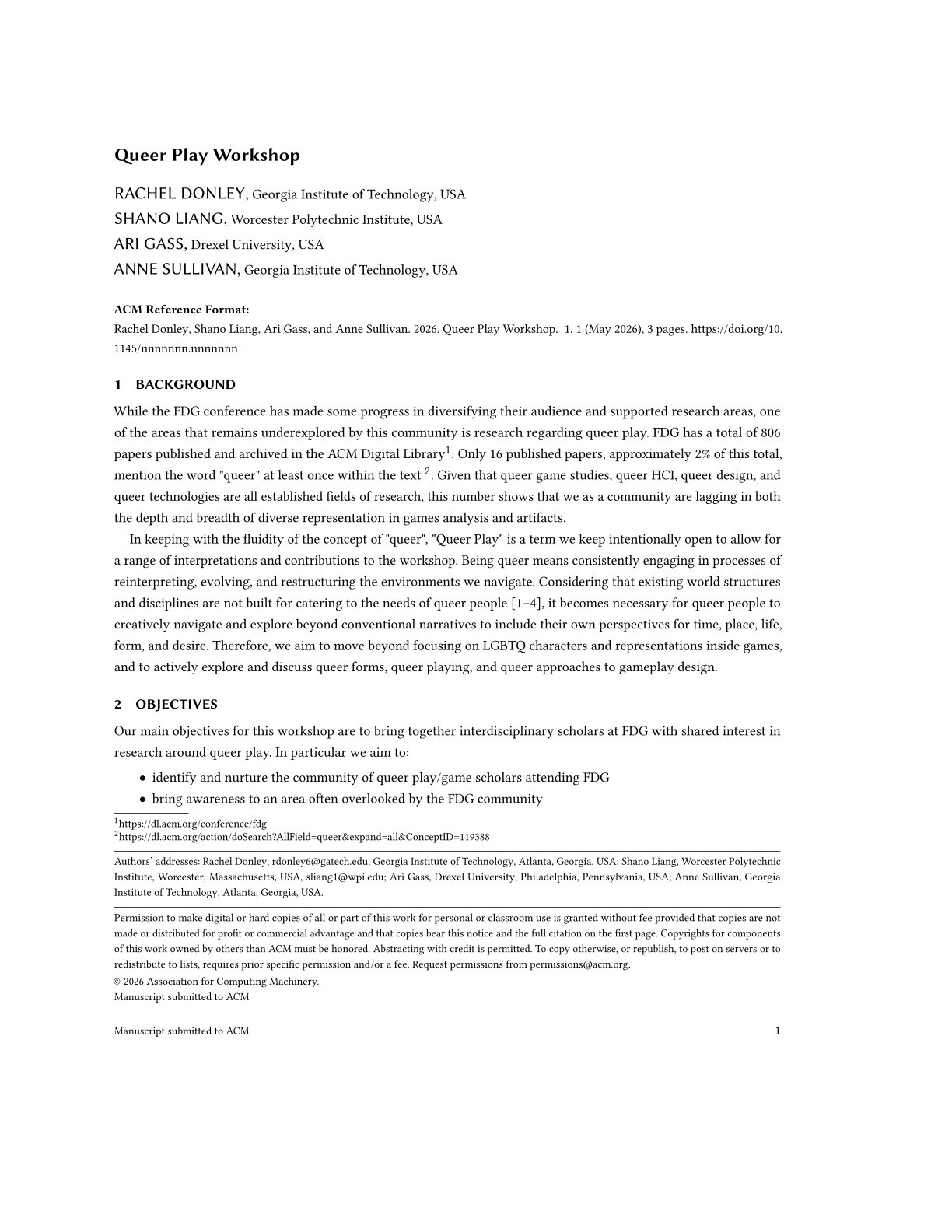
@misc{Donley2024session,
  title={Session details: Workshop on Queer Play},
  author={Donley, Rachel and Liang, Shano and Gass, Ari and Sullivan, Anne},
  booktitle={Proceedings of the 19th International Conference on the Foundations of Digital Games},
  howpublished = {Conference Workshop},
  url={https://sites.gatech.edu/queerplay/},
  year={2024}
} In keeping with the fluidity of the concept of “queer”, “Queer Play” is a term we keep intentionally open to allow for a range of interpretations and contributions to the workshop. Being queer means consistently engaging in processes of reinterpreting, evolving, and restructuring the environments we navigate. Considering that existing world structures and disciplines are not built for catering to the needs of queer people, it becomes necessary for queer people to creatively navigate and explore beyond conventional narratives to include their own perspectives for time, place, life, form, and desire. Therefore, we aim to move beyond focusing on LGBTQ characters and representations inside games, and to actively explore and discuss queer forms, queer playing, and queer approaches to gameplay design.
2023
Representation%20in%20Video%20Games.png)
@article{Liang2023Dysphoria,
author = {Liang, Shano and Cormier, Michelle V. and Toups Dugas, Phoebe O. and Bohrer, Rose},
title = {Analyzing Trans (Mis)Representation in Video Games to Remediate Gender Dysphoria Triggers},
year = {2023},
publisher = {Association for Computing Machinery},
address = {New York, NY, USA},
volume = {7},
number = {CHI PLAY},
doi = {10.1145/3611034},
journal = {Proc. ACM Hum.-Comput. Interact.},
month = oct,
articleno = {388},
numpages = {33}
} Many trans people experience gender dysphoria -- distress caused by mismatches in internal and external experiences of gender. Video games engage intimately with the self, creating intense experiences involving identities, bodies, and social interaction. This combination of factors renders trans players vulnerable to gender dysphoria triggers: failures of interaction design that result in gender dysphoria. The present research undertakes a thematic analysis of four popular games, drawn from an initial corpus of 31. It contributes a definition of gender dysphoria triggers, case studies of triggering games, an initial gender dysphoria categorization to provide a useful design language, and examples of alternative designs for extant triggers. The analysis combines the authors' positionality as trans gamers; critical cultural studies methodologies, including textual analysis; a critical discourse analysis of production-side statements and interviews and player-side comments about diversity in those games; and close readings of the games themselves. The paper concludes with a call for trans inclusivity in game design, which we structure around the necropolitical concept of the relation of care.
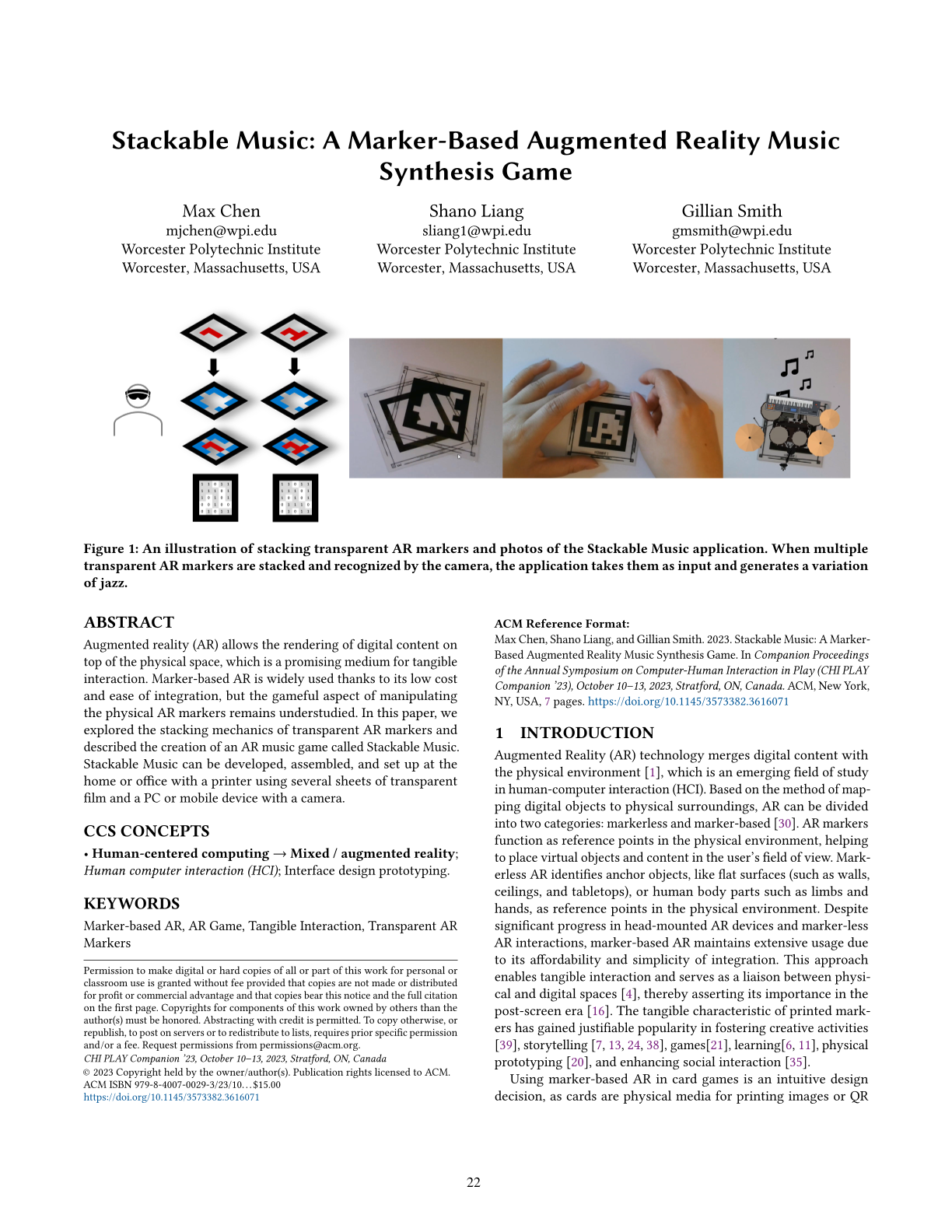
@inproceedings{Chen2023Stackable,
author = {Chen, Max and Liang, Shano and Smith, Gillian},
title = {Stackable Music: A Marker-Based Augmented Reality Music Synthesis Game},
year = {2023},
isbn = {9798400700293},
publisher = {Association for Computing Machinery},
address = {New York, NY, USA},
doi = {10.1145/3573382.3616071},
booktitle = {Companion Proceedings of the Annual Symposium on Computer-Human Interaction in Play},
pages = {22–28},
numpages = {7},
series = {CHI PLAY Companion '23}
} Augmented reality (AR) allows the rendering of digital content on top of the physical space, which is a promising medium for tangible interaction. Marker-based AR is widely used thanks to its low cost and ease of integration, but the gameful aspect of manipulating the physical AR markers remains understudied. In this paper, we explored the stacking mechanics of transparent AR markers and described the creation of an AR music game called Stackable Music. Stackable Music can be developed, assembled, and set up at the home or office with a printer using several sheets of transparent film and a PC or mobile device with a camera.
2022
@article{Liang2022review,
 issn = {24694053},
 url = {https://www.jstor.org/stable/48749196},
 author = {Shano Liang and Michael Anthony DeAnda},
 journal = {Lateral},
 number = {2},
 numpage = {5},
 publisher = {Cultural Studies Association},
 reviewed-author = {micha c{\'a}rdenas},
 title = {Review of Poetic Operations: Trans of Color Art in Digital Media by micha c{\'a}rdenas (Duke University Press)},
 urldate = {2026-05-20},
 volume = {11},
 year = {2022},
 bdsk-url-1 = {https://www.jstor.org/stable/48749196}
} Poetic Operations by micha cárdenas critically engages theory, activist, art, design, and lived experience to develop “trans of color poetics” to disrupt systems marking trans of color lives for death.
@inproceedings{Dempski2022integrating,
  title = {Integrating Immersive Learning Tools across Campus and Beyond},
  author = {Dempski, Robert and Teixeira, Andrew R and Li, Claire and Liang, Shano and Chen, Max},
  booktitle = {AIChE},
  url = {https://aiche.confex.com/aiche/ampc20/meetingapp.cgi/Paper/651137},
  year = {2022},
} Recent developments in technology and learning sciences alongside pandemic era restrictions have provided ample opportunities to develop, implement and assess immersive learning tools for academic and industrial settings. To deploy our AR and VR tools more efficiently across campus and beyond, we created the Intentional Design Studio (IdeaS). IdeaS merges arts, science and engineering disciplines with digital media research and production. IdeaS focuses on value creation through a broad spectrum of digital media products that support and promote faculty research and teaching, scholarship and external partnerships. To do this, IdeaS trains and employs undergraduate and graduate students to support innovative projects using cutting-edge hardware and software technologies in immersive/interactive media tools. At the same time, IdeaS partners with underserved communities to enhance affordable and accessible educational and research opportunities (worldwide training, K-12 outreach, asynchronous learning, connectivity, mental health). Here, we will describe some of our efforts in the areas of laboratory safety, remote instruction and apps designed to improve classroom learning outcomes.
Shano Liang (she/her)
Email: sliang1 AT wpi DOT edu