ReVISit-XR Suite
Tags: Data Visualization Infrastructure Extended Reality
Date: Oct. 2025 - Present
Collaborators: Max Chen, Lane Harrison
My Role: Lead Author
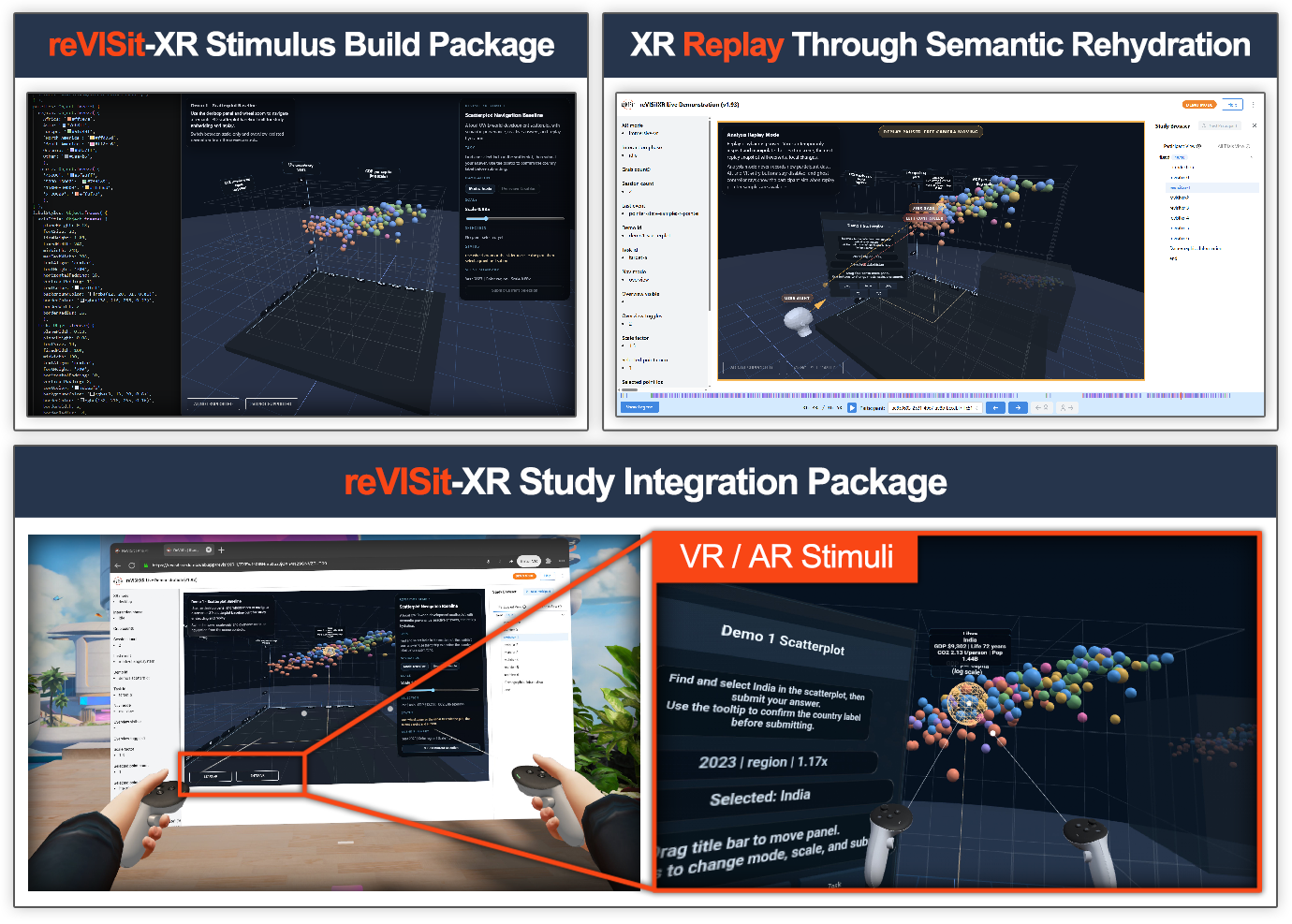
The reVISit-XR Suite is a research infrastructure project that extends reVISit to support embeddable, trackable, and replayable WebXR (including virtual reality and augmented reality) stimuli for empirical visualization studies.

INTRODUCTION
Extended reality has become an important setting for visualization research because it allows researchers to study spatial, embodied, and situated forms of data interaction. However, XR studies also create methodological challenges that are harder to handle with ordinary web-study infrastructure. Meaningful study state may be distributed across headset pose, controller movement, selected objects, scene configuration, AR anchors, spatial layouts, interaction events, and participant responses. Recording too little can make later interpretation ambiguous, while dense frame-by-frame traces can be difficult to inspect or connect to task-level behavior. ReVISit-XR addresses this gap by extending reVISit so that WebXR stimuli can be embedded in study flows, tracked during headset interaction, and replayed afterward for analysis. The paper reporting this system is currently under review; more details, results, and discussion will be added after peer review is complete.
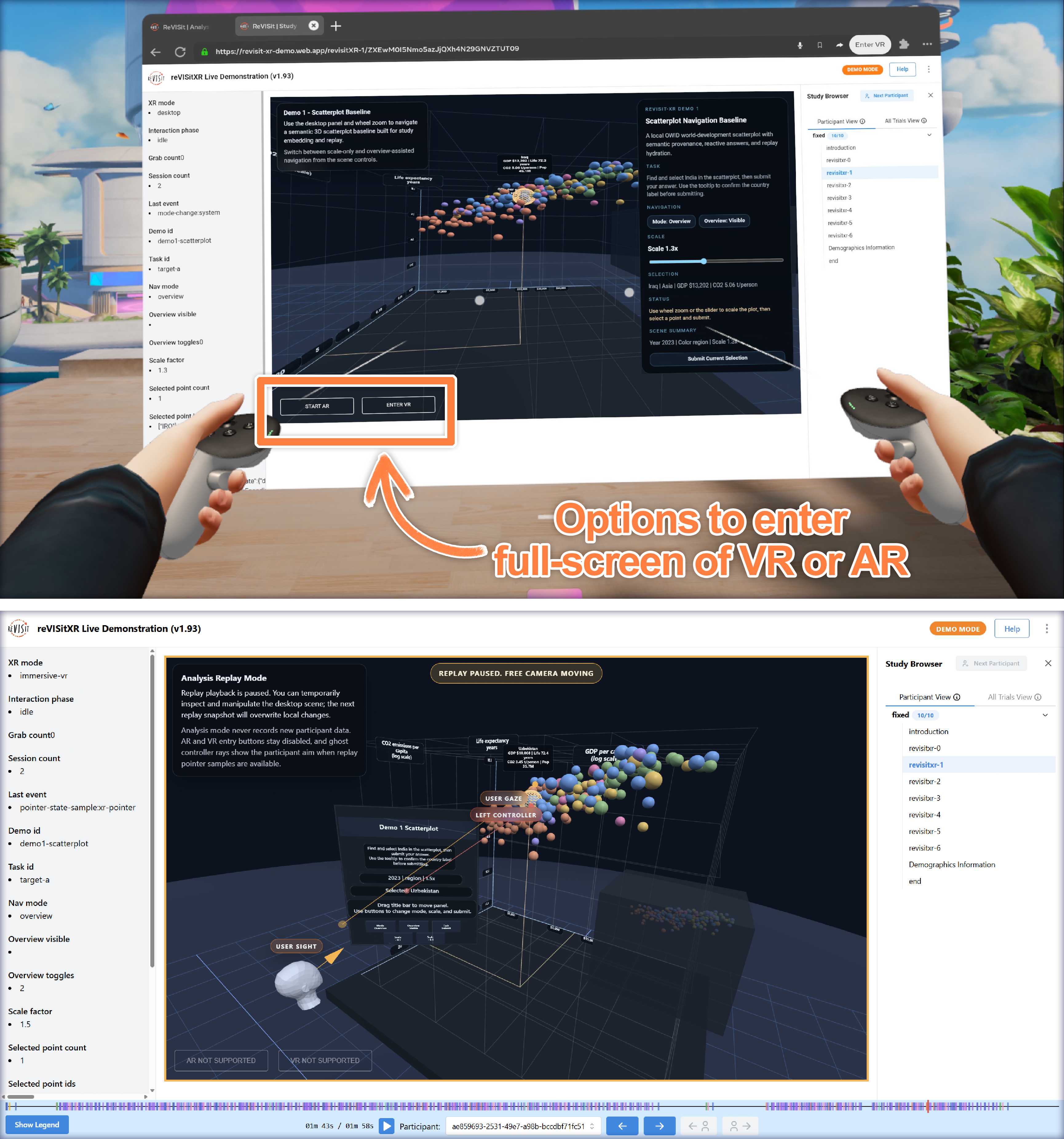
Top: entering embedded XR stimuli from a reVISit study on Meta Quest 3. Bottom: frame-by-frame replay of participant XR interactions.
REVISIT-XR FRAMEWORK
ReVISit-XR is organized around two complementary parts: a Stimulus Build Package and a Study Integration Package. The Stimulus Build Package provides a reusable WebXR runtime for building and managing XR scenes, including scene registration, Three.js/WebXR scaffolding, input handling, logging, serialization, replay visuals, and reusable scene helpers. The Study Integration Package embeds the built XR runtime into reVISit as website components, allowing XR trials to be sequenced with ordinary study elements such as instructions, consent materials, questionnaires, attention checks, and demographics. A key design principle is semantic provenance: instead of treating every rendered transform as a study record, each XR scene captures compact task-level state, such as selected objects, filter settings, panel layouts, AR placement state, comparison mode, or game outcomes. During analysis, reVISit-XR uses semantic state rehydration to reconstruct what the participant saw, selected, arranged, or triggered at a given moment.
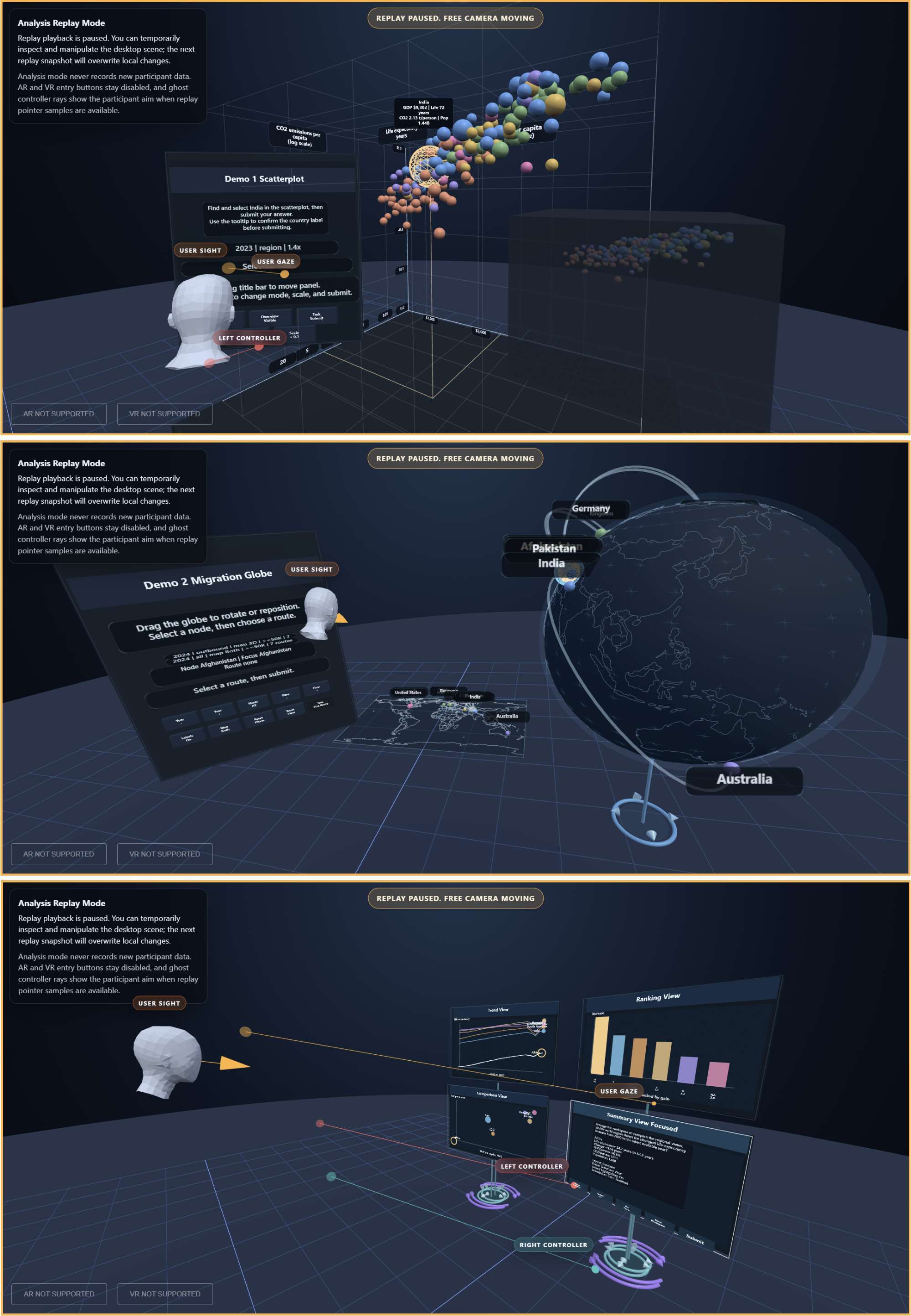
reVISit-XR usage examples (1-3)
REUSABLE XR STUDY EXAMPLES
To demonstrate the scope of the system, we implemented six reusable XR study examples that cover recurring visualization-study needs. These examples include immersive abstract visualization, a 3D scatterplot with navigation and selection, an immersive flow map with geospatial filtering, a spatial multi-view workspace, a situated AR overlay, landmark-scale visceralization, and a compact VR mini-game for embodied interaction logging. Together, these examples show how reVISit-XR can support different forms of XR study state, including navigation, selection, spatial layout, AR anchoring, embodied scale comparison, and event-based interaction records. The project remains part of a broader infrastructure effort rather than a finished endpoint. Future work includes community-informed extensions, support for more diverse XR study practices, and richer interpretation of embodied behavior such as gestures, gaze trajectories, drawing actions, and lapses of attention.
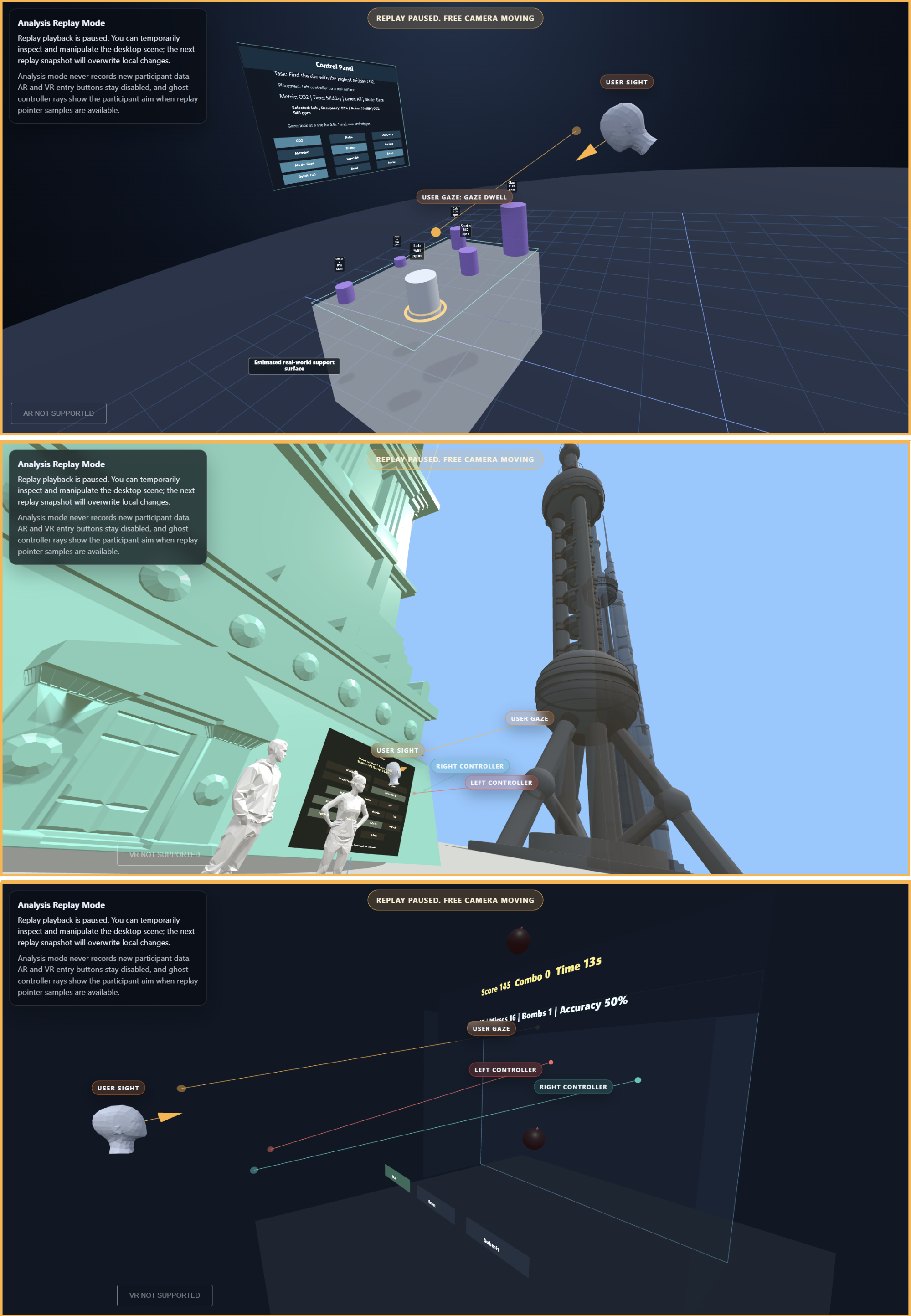
reVISit-XR usage examples (4-6)
Project: ReVISit-XR Suite
The Page Last updated: May 29, 2026