Juicy Interactive Visualization
Tags: Game Design Data Visualization Interactive Experience
Date: Jan. 2026 - May. 2026
Collaborators: Max Chen, Lane Harrison
My Role: Lead Author
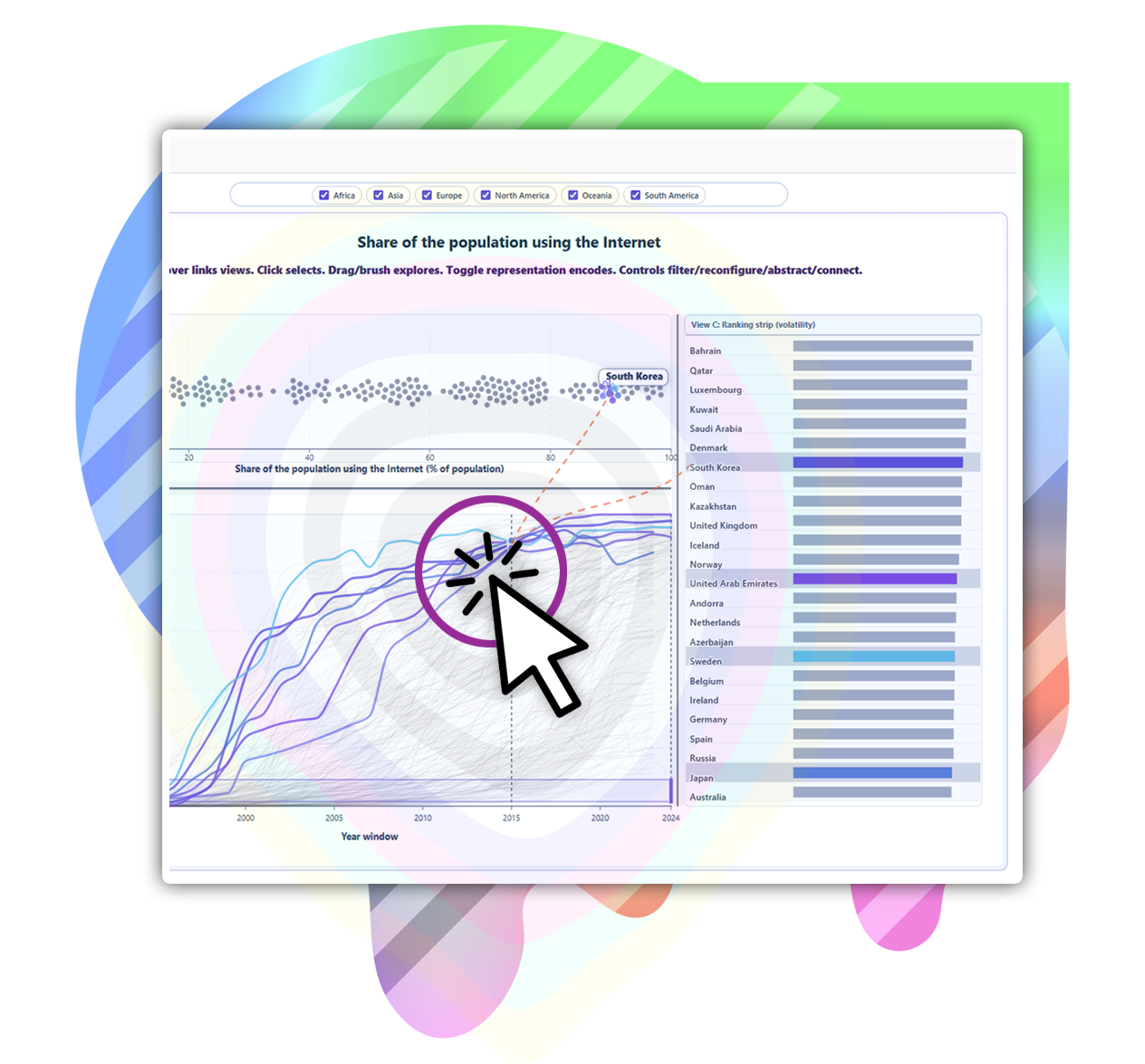
JuicyVIS is a theory-informed operationalization and instantiation of juicy feedback for interactive visualization that translates the "juicy" concept from game studies into a visualization-centered framework. We build 26 controlled prototypes and evaluate the juicy design space through three online studies.
INTRODUCTION
"Juice," or "juiciness," a concept widely adopted in game and interactive media studies, refers to the quality of excessive amounts of feedback in relation to user input, while design and feedback that exhibit this quality are considered "juicy." It has been used to explain why seemingly small micro-feedback can motivate continued interaction. In parallel, visualization interaction researchers have argued that feedback is central to effective interaction, yet few studies have systematically mapped feedback-centric design choices onto established interaction categories: many systems are functionally correct yet respond so minimally that interaction feels experientially "thin." Games have long treated interaction quality as a core design material. We turn to game studies for a vocabulary suited to this gap, taking juicy feedback design as a lens for articulating the experiential "thickness" of visualization feedback. Building on this prior groundwork, we present JuicyVIS, a theory-informed operationalization of juicy interaction feedback for data visualization. We map juiciness onto established visualization interaction types and instantiate three design dimensions. We then conduct three online studies, examining how these dimensions relate to engagement, aesthetic experience, preference, and task-related outcomes.
Table 1: The Juice Elements Palette, that is used to construct and document the JuicyVIS stimuli. The palette is an operational vocabulary, not an exhaustive taxonomy.
INTERACTION IN VISUALIZATION
Because juiciness concerns input-contingent feedback, studying juicy feedback in visualization first requires specifying which user actions constitute interaction events and thus can be "juicified." Two frameworks are mostly relevant: Yi et al.'s work propose a grounded, intent-oriented taxonomy of seven interaction archetypes. In parallel, Dimara and Perin's work synthesize an intentionally inclusive view of interaction for data visualization, framing interaction as a broad space of actions across the visualization pipeline. This pattern follows from the different organizing logics of the two frameworks. Yi et al. classify interaction by user intent, offering seven categories for characterizing what users seek to accomplish through interaction. Dimara and Perin, by contrast, broaden the scope of visualization interaction and organize it by where actions occur semantically in the visualization pipeline. For our purposes, we focus on input-contingent feedback tied to representation-level interactions experienced by users within an already instantiated visualization. Accordingly, Yi et al.'s taxonomy provides a more suitable operational framework for constructing controlled stimuli.
[No direct counterpart]
(6) Filter: “show me something conditionally” (e.g., control to show/hide subsets)
(3) Reconfigure: “show me a different arrangement” (e.g., reorder)
(4) Encode: “show me a different representation” (e.g., change visual encodings such as color or shape)
(1) Select: “mark something as interesting” (e.g., mark a data item)
(2) Explore: “show me something else” (e.g., move to another subset)
(5) Abstract / Elaborate: “show me more or less detail” (e.g., drill down)
(6) Filter: “show me something conditionally”
(7) Connect: “show me related items” (e.g., highlight linked items)
[No direct counterpart]
[No direct counterpart]
[No direct counterpart]
(1.1) Input Data Actions: “operate on raw data values”
(1.2) Processing Data Actions: “apply functions/transformations to the input/raw data” (e.g., compile)
(2.1) Mapping Data Actions: “assign data entities to perceptual marks and variables, and layout/rearrange the data”
(2.2) Presentation Data Actions: “operate on the specific presentation of the data” (e.g., mark something as interesting; navigate; stylize; highlight; decorate)
(3.1) Meta Actions: “operate on the person's own actions”
(3.2) Social Actions: “connect the person to other persons”
(3.3) Interface Actions: “operate on other data interface components”
Table 2: Comparison of Yi et al.'s work and Dimara and Perin's work on visualization interaction taxonomies. The pairings shown here represent interpretive, closest correspondences rather than exact matches.
JUICINESS IN GAME STUDIES
Similar to the interaction in visualization studies, juiciness is also widely invoked but inconsistently defined across game studies. In an early practitioner articulation, Gabler et al. describe juicy game elements as ones that "will bounce and wiggle and squirt and make a little noise when you touch it." This description defines juiciness from a person-internal experiential intuition, while subsequent work retains this general intuition and expands the definition (but diverges in emphasis). Longanecker and Brown, for example, frame juiciness from the perspective of experiential results, claiming the juicy feedback is an interaction quality to elicit visceral and highly satisfying responses. Hicks et al. describe juiciness as abundant or redundant audiovisual feedback triggered by player action. Following recent work in human-computer interaction, we use Kao et al.'s definition of juiciness as "the design feature of immediate excessive amounts of feedback in relation to user input at the level ofmoment-to-moment interaction." The use of this definition does not attempt to cover every quality sometimes associated with juicy design (e.g., haptic or other multi-sensory aspects), but is based on this operational (and we consider tractable) definition to translate the juiciness concept into visualization interaction.
Adds crosshair guides P_TG; hover adds sound Au_AC, point pop A_PB, category tint P_SH, and de-emphasis P_SH; click adds confirmation sound Au_CS, shake S_IS, particles Pa_CB, and pop highlight A_PB.
Adds pan-zoom grab cues (press ring P_TG, vignette P_TG, border P_TG, crosshair P_TG, arrows P_TG); panning adds motion sounds Au_AS and arrow flashes A_FG; zooming adds stepwise sounds Au_AS.
Adds slider arrows P_TG and a translucent reorder preview P_PG; commit triggers sorting animation A_TR, tick sounds Au_AS, confirmation cue Au_CS, shake S_IS, and particles Pa_CB.
Adds hover previews of alter representations P_PG; switches use animated transitions A_TR with vignette P_TG, outline P_TG, shake S_IS, staged motion A_TR/sound Au_AS, and completion cues Au_CS; color changes add smooth recoloring A_TR and local highlight P_SH.
Adds drill feedback via animated tile entry/exit A_TR, transition audio Au_AS, brief blur/frame overlays A_TR, and particles Pa_CB; invalid drills trigger an error cue Au_ES and shake S_ErS.
Adds slider-hover cues via vignette P_TG, outline P_TG, and threshold highlighting P_TG; scrubbing adds tick sounds Au_AS, flashes A_FG, and animated line entry/exit A_TR; completion adds shake S_IS and a popping A_PB matched-count badge P_SB.
Adds cross-view hover linking via hovered-mark emphasis P_SH and an animated bridge cue A_TR; selection adds connecting sound Au_CS, impact flash A_FG, selected-ring animation P_SH, shake S_IS, and staggered reveal of related items A_TR.
Table 3: Juicy feedback implemented for each interaction type. Colored terms and tags map each effect to a sub-category of the Juice Elements Palette Tab. 1.
Project: Juicy Interactive Visualization
The Page Last updated: September 8, 2026