
"Jùběnshā" (剧本杀)
Tags: Game Taxonomy Murder Mystery Cross-cultural
Years Active: Jan. 2022 - Feb. 2025
Main Collaborator: Max Chen
My Role: Lead Author
A multi-year game studies project examining Jubensha, an emergent murder mystery styled group gaming phenomenon in China, through taxonomy, analysis, and prototyping. The project investigates how Jubensha organizes collaborative sensemaking, distributed cognition, social deduction, and narrative performance.

JUBENSHA INTRODUCTION
剧本杀 (Jubensha) is an emergent category of script-centered multiplayer games in China -- an experience of distributed cognition and sensemaking. Rather than centering only on winning or losing, Jubensha games ask players to collaboratively make sense of an unfolding fictional story through reading, discussion, information sharing, interpretation, and selective disclosure. A typical Jubensha game involves four to eight players, who may play together in board game cafés or remotely through mobile platforms with voice communication. Players progress through cold script readings, group interaction, investigation, and discussion as they uncover and experience the story from multiple perspectives. Jubensha has grown rapidly in mainland China since the late 2010s, with thousands of physical stores, board game cafés, and digital platforms supporting this form of play.
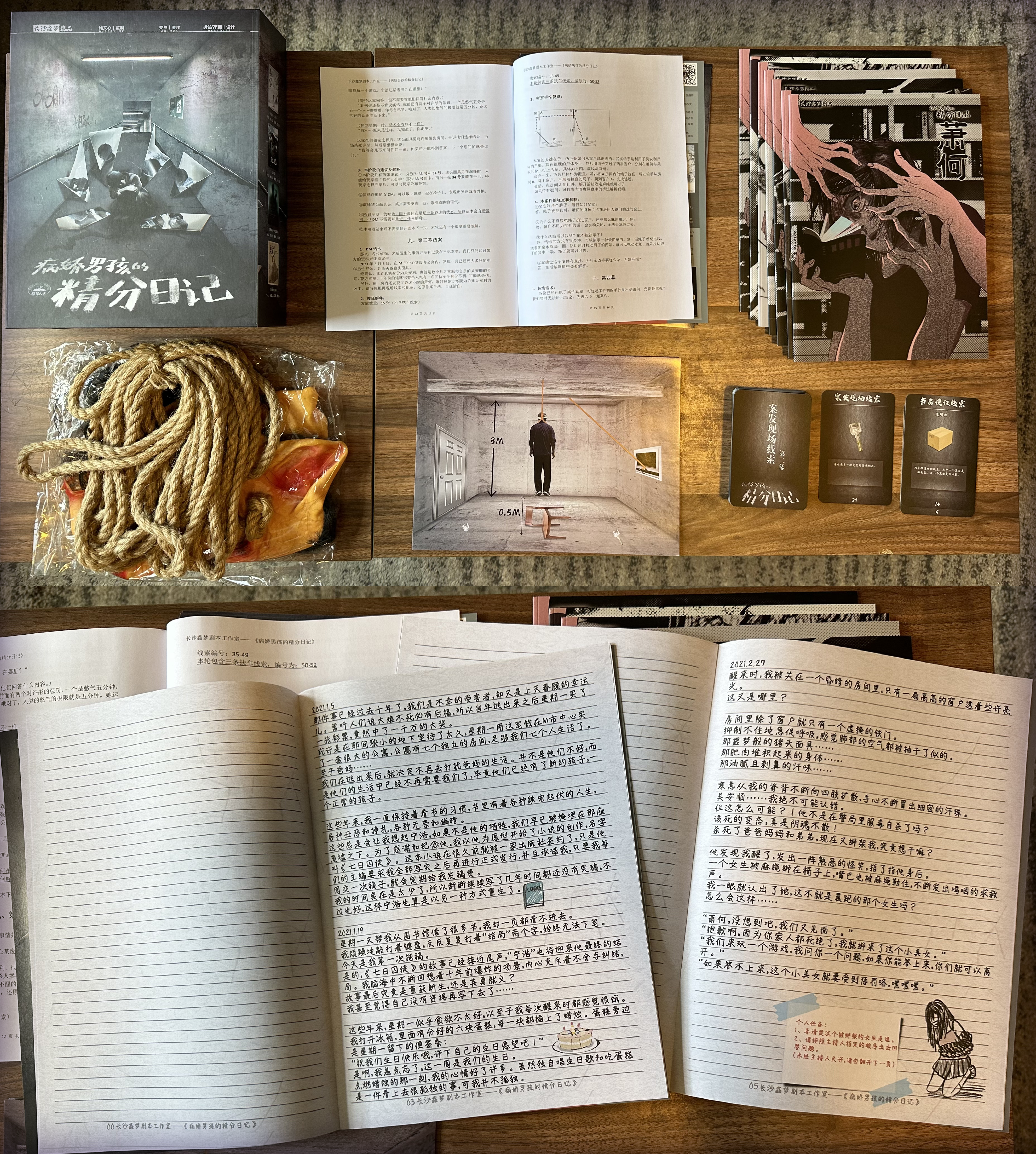
Photo of a physical Jubensha game
Early Explorations
Around 2020, as Jubensha became increasingly visible in mainland China's popular gaming culture, I became interested in analyzing how its distinctive experience was designed: what game mechanisms made it feel different, how players collectively reconstructed fictional events, and how those mechanisms could be described through useful explanatory and design frameworks. In early 2022, Max Chen and I began a systematic investigation of Jubensha as an emerging game phenomenon. Our early work examined its historical and design relationships to precursor genres such as murder mystery games, role-playing games, and social deduction games, while also questioning whether Jubensha should be understood merely as a localized form of murder mystery or as a distinct category of script-centered group play. In June 2022, we presented an early version of this work at the Canadian Game Studies Association Annual Conference in a talk titled "The Importation of Murder Mystery Games in China: Game Localization and Creativity."

Photo of Collection, our Jubensha-inspired experiment game
Experiment Game (2022)
In spring 2022, we also created Collection, a Jubensha-inspired experiment combining nonlinear storytelling, tangible interaction, and origami. The piece took the form of an opened mail package containing a letter and a treasure box. Inside the box were old newspaper clippings, lab notes, drawings, and diary fragments that together suggested a tragedy surrounding the Werner family. The project explored how fragmented physical materials could invite players to reconstruct a story from multiple partial perspectives. Because tangible artifacts such as boxes, folded papers, and loose documents naturally afford rearrangement, Collection also experimented with how changes in the order of discovery could produce different causal interpretations and emotional readings of the same scenario. Collection was exhibited at PAX East 2022 in April of that year.

Poster of Collection for PAX East 2022
Further Studies (2023-2024)
In 2023, I led the formation of a larger research team to conduct a more systematic taxonomy and analysis of Jubensha games. We began by examining Chinese Jubensha community websites, gaming platforms, and major mobile applications, then identified more than 100 games before refining the research corpus to 83 Jubensha games. Our analysis combined reflexive thematic analysis with three lenses: close reading of games, discourse analysis, and distributed cognition. Close reading involved playing and carefully documenting each game to understand the interactive, narrative, and social details of the experience. Across games for which playtime records were preserved, the close-reading process totaled more than 406 hours. Through this process, we developed initial themantic analysis codes from recurring play strategies, narrative structures, player interactions, design patterns, and community terminology. In May 2024, we presented a stage of this work at the 19th International Conference on the Foundations of Digital Games (FDG '24).
Slides of presenting on FDG '24
Trailer video of Collection for PAX East 2022
Final Publication (2024-2025)
In the final stage of the project, we refined these codes into a taxonomy themes organized through the Design, Dynamics, Experience (DDE) framework. The resulting taxonomy describes Jubensha games in terms of their designed structures, the player and system dynamics that emerge during play, and the experiences produced through collaborative interpretation. The final paper, "The Collaborative Sensemaking Play of Jubensha Games: A Deconstruction, Taxonomy, and Analysis," was published in ACM Games: Research and Practice. Through this work, we provide researchers and designers with a descriptive vocabulary for understanding Jubensha as a form of collaborative sensemaking play and for translating its narrative and interaction structures into future game design contexts.
Blueprint
Scene(s)
Narrative Strategies Themes
- Linear Narrative
- Reverse
- Chronology
- Multiperspectivity
Player Goals Themes
- Multi-scene Goals
- Single-scene Goals
- Optional Goals
Mechanics
Mechanics Themes
- Scriptreading (读本)
- Tablereading (小剧场)
- Investigation (搜证)
- Player Discussion (讨论)
- Poll (投票)
Interface
- Story or narrative content
- Graphic Assets
- Audio Assets
Gamehost
Player ⇔ Game
Individual Sensemaking
- Scripted Narrative Involvement
- Ludic Narrative Involvement
- Spatial Narrative Involvement
Player ⇔ Player
Collaborative Sensemaking
- Affective Narrative Involvement
- Shared Narrative Involvement
- Kinaesthetic Narrative Involvement
Game ⇔ Game
Distributed Information
Emotional Journey
Social-focused
Subthemes:
- Romantic
- Patriotic
- Sympathetic
- ...
Balanced
Social-focused
Subthemes:
- Faction-confronting
- Resource-managing
- Character-developing
- ...
Intellectual Journey
Detective-focused
Subthemes:
- Honkaku
- Henkaku
- Shin-Honkaku
- ...
Jubensha taxonomy themes under DDE framework
Project: "Jubensha"
The Page Last updated: May 25, 2026