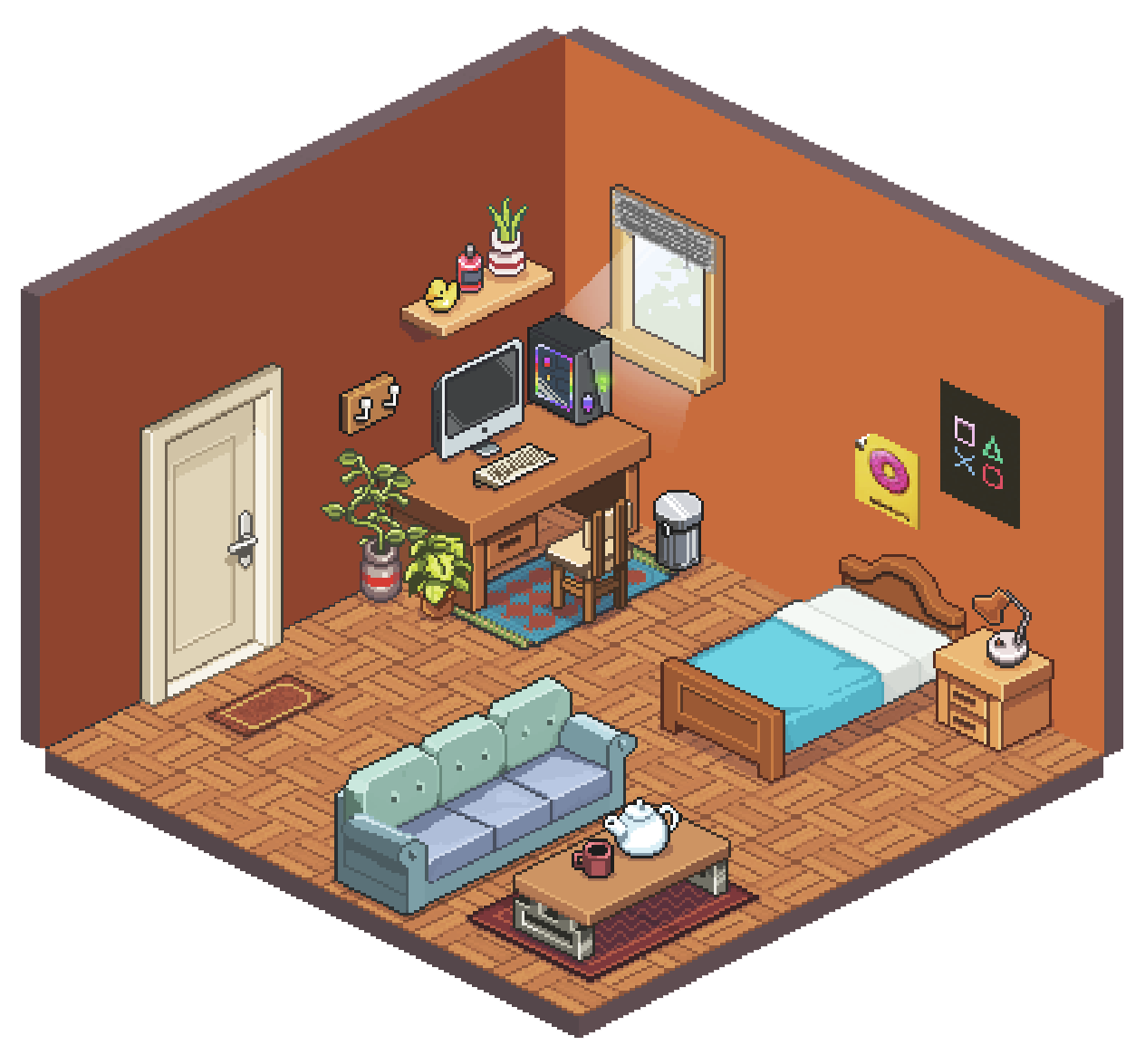
Euphoria & Rainborough
Tags: Mental Health Trans Game Studies Marginalized Group Psychology
Date: 2024 - Present
Collaborators: Max Chen, Bastión Toledo-Altamirano, Elizabeth Papa, Crow Zubrick, Thea Cloyd, Rose Bohrer, Michelle V. Cormier, Gillian Smith, Lane Harrison, Phoebe O. Toups Dugas
My Role: Lead Author
A multi-stage line of research on transgender gender euphoria in games, moving from theory-building and design framework to prototyping and reflective practice through a research game, Rainborough. This work asks how interactive media can do more than avoid harm -- how they might actively support affirmation, resilience, and wellbeing for trans players.

WHAT IS EUPHORIA?
Gender euphoria refers to positive feelings such as joy, relief, affirmation, and self-actualization that can emerge when someone's gender identity feels congruent with their experience, expression, or recognition. In HCI and game studies, work on trans inclusion has often focused -- necessarily -- on harm: dysphoria triggers, exclusion, misrepresentation, and harassment. That work remains essential, but it leaves less language for designing affirmative experiences. Games matter here because they are powerful engines of identity, embodiment, and feeling; they can support both dysphoria and euphoria, making them an important site for studying how interactive systems might actively support gendered wellbeing.
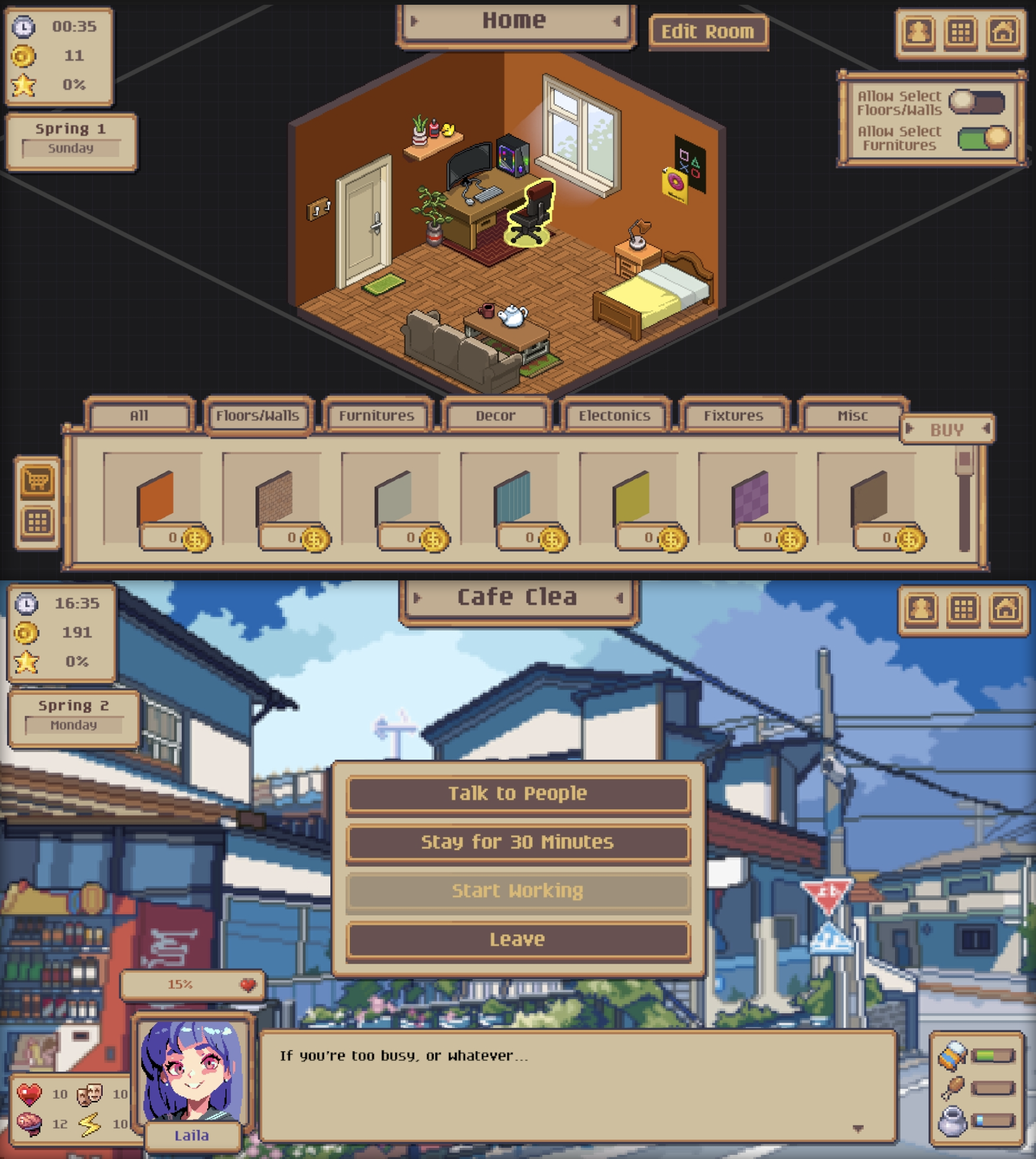
Screenshots of our developed research game, Rainborough
DISCOVERED EUPHORIA
My first paper in this line of work, Designed & Discovered Euphoria, developed an operational framework for transgender gender euphoria in games through a reflexive thematic analysis of 25 games, with in-depth case analysis of four of them. The paper identified four design themes -- destigmatization, de-othering, offer expression, and self-disclosure -- along with four dynamics (trans trust, safe spaces, continuum of comfort, self-reflection) and five experience themes (self-image, external, social, parasocial, institutional). It also described two recurring patterns: "a place of my own," where self-expression and safety support joyful self-image, and "reflective role models," where story-sharing and resonance support parasocial reflection and recognition. The paper was published at CHI 2025 and received Honorable Mention Award!!
DESTIGMATIZATION
An authentic representation of trans characters that includes social acceptance and avoids misrepresentation.
DEOTHERING
A focus on trans inclusion in social groups and activities such that we are not a separate group outside a norm.
OFFER EXPRESSION
Develop many options for self-expression through the game, such as avatar customization or apparel changes.
SELF-DISCLOSURE
Modulating what the player knows about characters and ensuring that trans characters have control of their disclosures.
TRANS TRUST
Game scenarios in which a bond forms between characters, such that they share information and/or work with the PC.
SAFE SPACES
Game spaces in which a character is safe because there is no judgment about group identity and/or the player has control over disclosures.
CONTINUUM OF COMFORT
The possibility of encountering pain, hope, sadness, and/or joy through the game design.
SELF REFLECTION
The possibility of evoking resonance, self-understanding, or recalling players' life experiences.
SELF IMAGE
Observations of self identity (real world or in-game) that bring joy.
EXTERNAL
Joy derived from showing identity to others in the world as the authentic self.
SOCIAL
Experiences with how others (e.g., NPCs) take up an identity and/or respond to identities.
PARASOCIAL
One-sided relationships with PCs/NPCs and joy through a relationship with them.
INSTITUTIONAL
Experiences involving either supportive social structures or subverting unsupportive ones.
The identified 13 themes, organized under the design, dynamics, and experience (DDE) framework.
WHY BUILD RAINBOROUGH?
The next step in this research asked a harder question: what happens when these euphoria-oriented design principles are not only identified in existing games, but translated into a playable artifact? Rainborough was developed as a trans- and queer-led research game that operationalizes prior gender euphoria principles and uses implementation itself as a form of inquiry. Rather than assuming that euphoria can be straightforwardly generalized, the project treats prototyping as a way to study both the promise and the limits of affirmative design in practice. Our related postmortem paper published in the Journal of Games, Self, & Society further reflects on this move from framework to artifact, positioning Rainborough as a practical experiment in bringing gender euphoria into game development. In addition, a companion user-experience paper based on Rainborough is currently under review; once peer review is complete, more details, results, and discussion can be shared here.
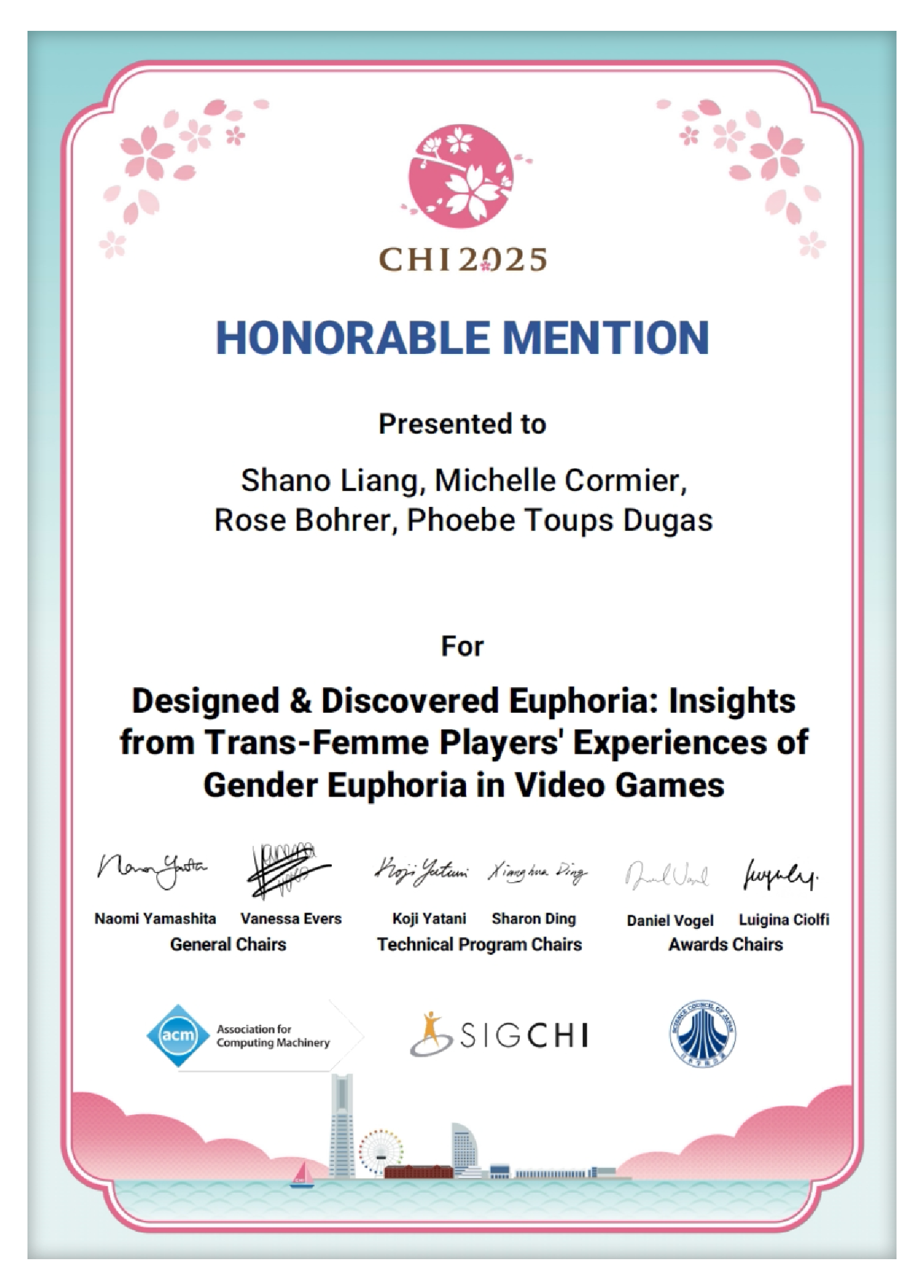
The honorable mention award of my Designed & Discovered Euphoria paper
IMPLEMENTING EUPHORIA
During development, we translated the earlier DDE framework into concrete game systems. Destigmatization and self-disclosure were implemented by having major trans characters conceived and written by trans writers drawing directly on lived experience. A visual-novel structure supported authored story-sharing and relational disclosure. Offer expression was implemented through space customization, allowing players to personalize and decorate an in-game home. De-othering was supported through a life-simulation layer that places trans identities within everyday routines, relationships, and social participation rather than isolating them as exceptional or external to the game world. At the same time, the team explicitly treated scope as a design responsibility: the prototype centers two authored trans binary major arcs, preserves nonbinary player-character configuration and gender-diverse side characters, and frames the lack of an authored nonbinary major arc as a limitation rather than universal coverage.
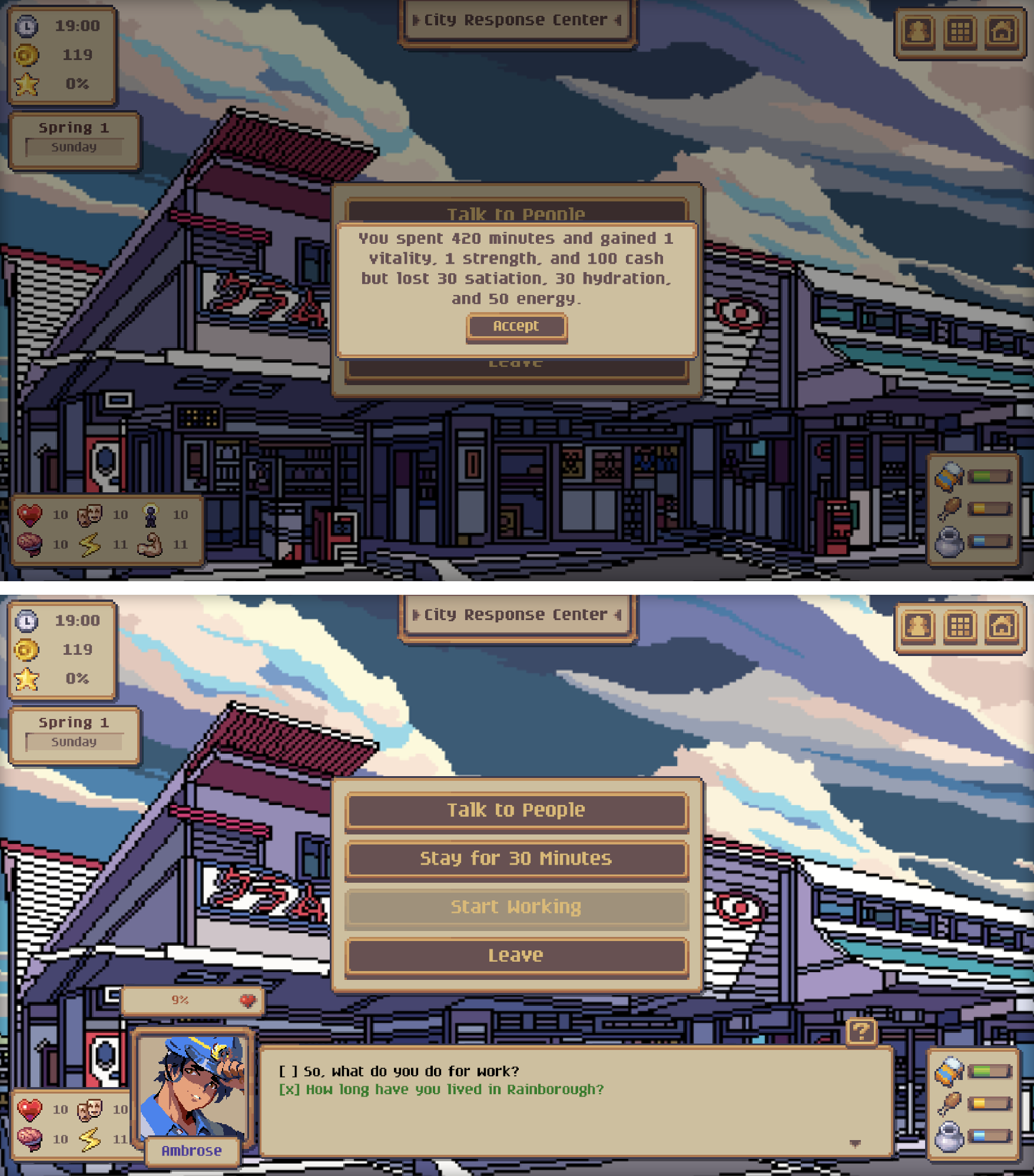
Screenshots of Rainborough
RAINBOROUGH GAMEPLAY
Rainborough is a life-simulation and visual-novel game set in a multicultural town of the same name. Its gameplay combines three connected systems: visual-novel interaction with NPCs, home-space customization, and daily-resource management. Players manage needs such as satiation, hydration, and energy while moving through town, working, shopping, and developing relationships. The narrative centers on two major authored trans NPC arcs—Laila, a trans woman, and Ambrose, a trans man—written from lived experience, alongside additional minor characters. Players also configure their own character's name, gender identity, occupation, and pronouns, including multiple-pronoun configurations, and those choices affect the language NPCs use in dialogue. The major relationship arcs unfold through a structured progression from first meeting to deeper trust and story-sharing.
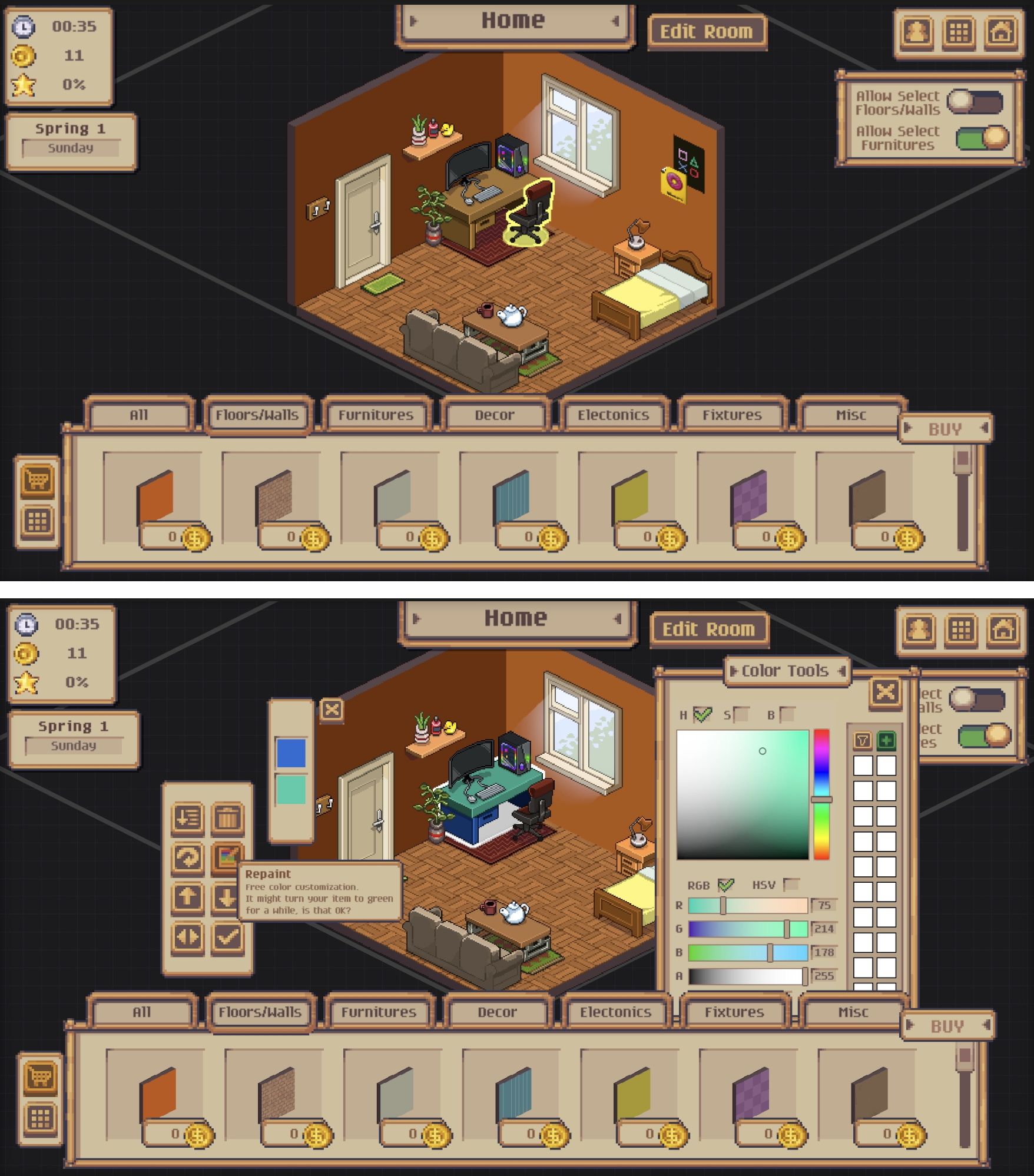
Screenshots of Rainborough: player's room customization gameplay
Why This Line of Work Matters
Our work argues that designing for euphoria is not simply the inverse of designing against harm. It is a distinct question about how interactive systems can support affirmation, recognition, belonging, reflection, and resilience—especially for marginalized players whose experiences are often framed only through distress. At the same time, both the Rainborough evaluation paper and the later postmortem emphasize that affirmative design is not simple or universally resolvable: players may report euphoric, ambivalent, insufficient, or uncomfortable experiences, and development choices about tone, realism, representation, and “safe” idealization carry real tradeoffs. One postmortem insight was that a world that feels too kind can become emotionally detached or uncanny, raising an important design question about whether euphoria-oriented games should function as ideal safe spaces, mixed emotional spaces, or something in between. For this insight, our another under review research paper discusses it in detail; once peer review is complete, more details can be shared here.
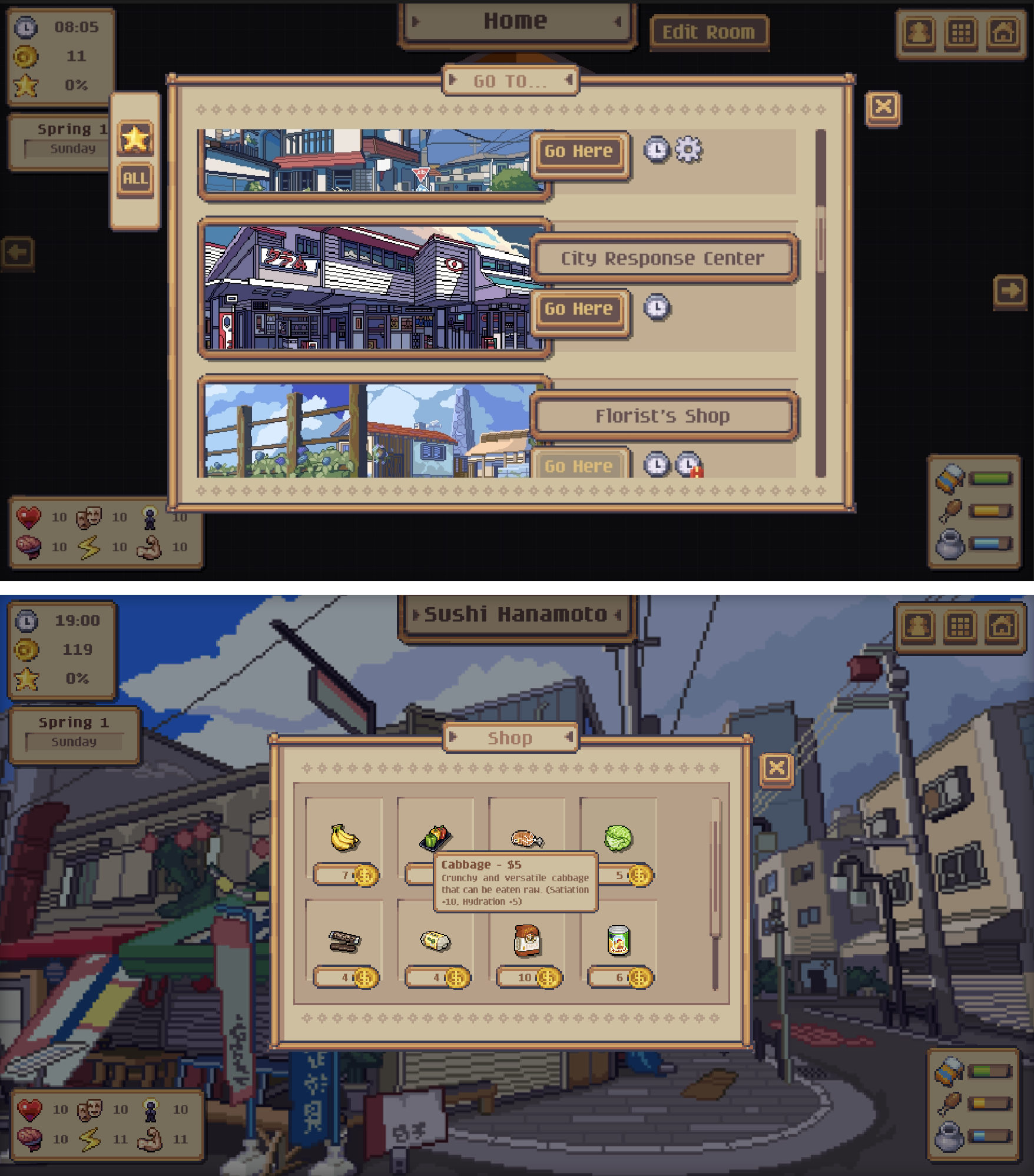
Screenshots of Rainborough
Playable Demo
Rainborough Demo on itch.io
Sound note: This game includes sound. Double-check audio settings for the best experience.
Opens an embedded itch.io WebGL demo in-place. Best on larger screens. On smaller or slower devices (e.g., mobile phones), please open the demo directly at rainborough.itch.io/demo to play.
Project: Euphoria & Rainborough
The Page Last updated: May 28, 2026